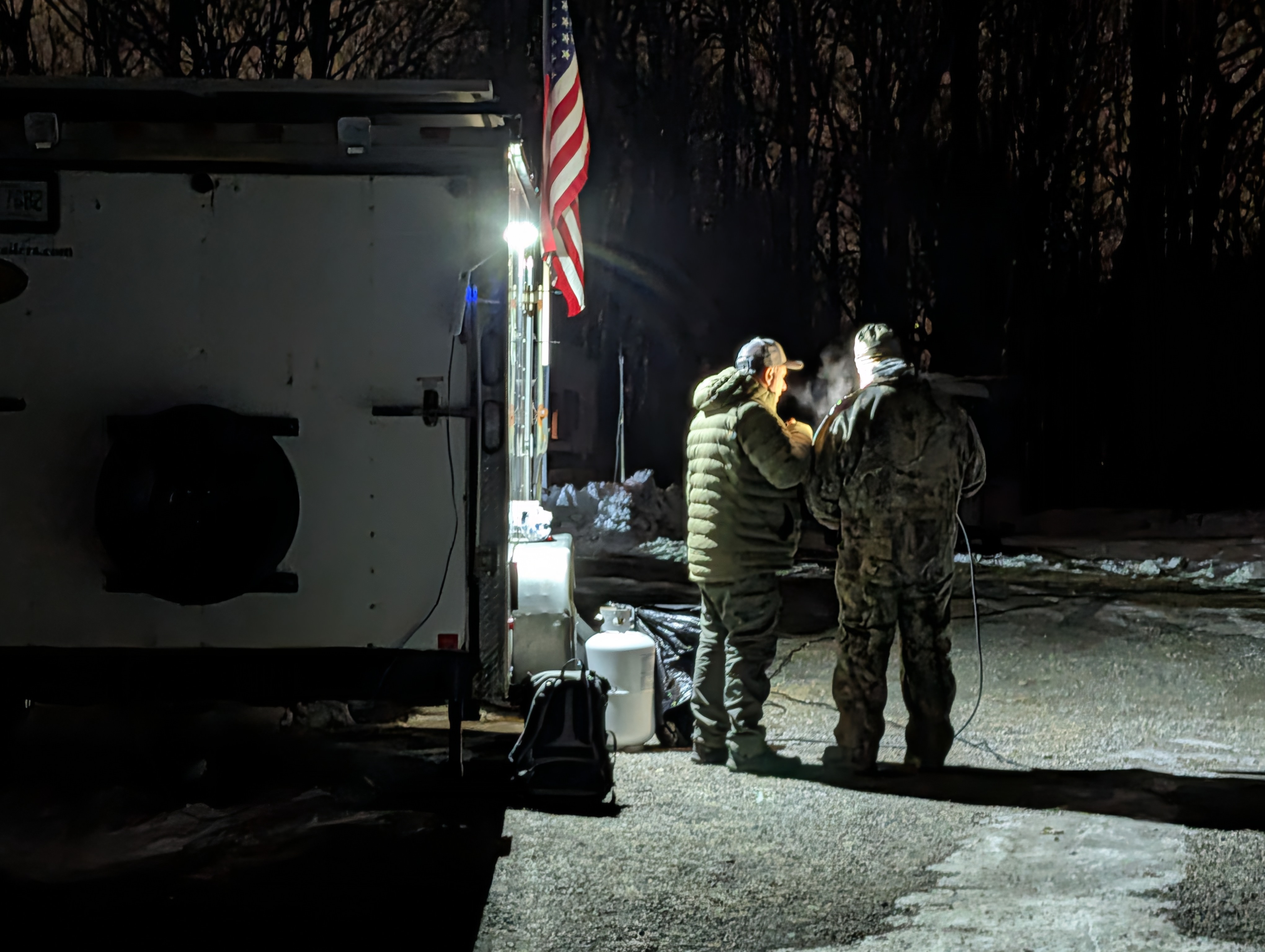
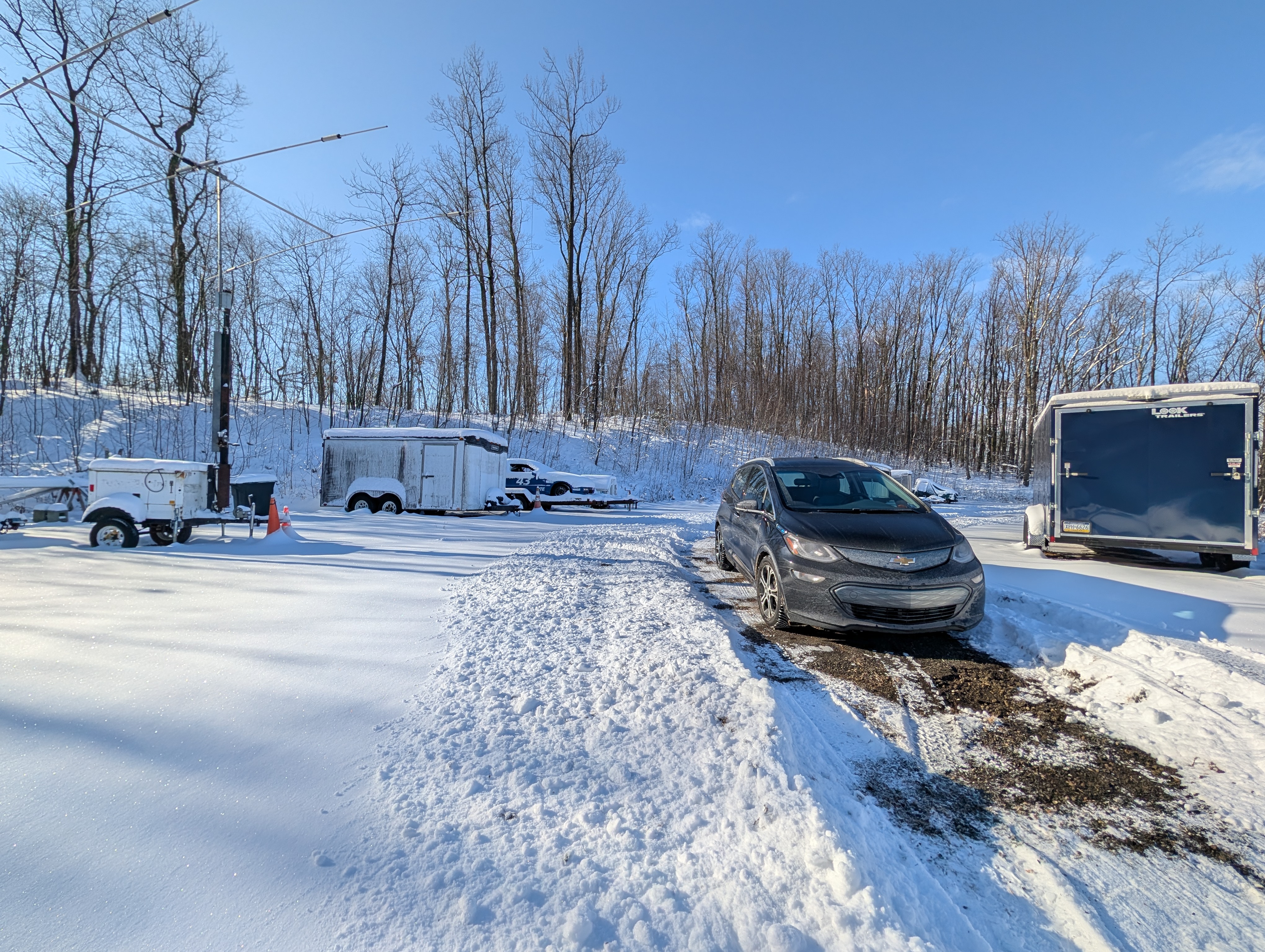
985 Workbench: 2026-02-16

My Week in Radio

  • CQ WW RTTY contest
    • 70 contacts in one afternoon
    • a little antenna maintenance in the middle
  • using pulleys in the tree for cleaner rope work in trees, learned from field day setup

Others

  • WA3VEE, Ron:
    • worked with Drexel club to get them back on the air next month
      • lapsed license
    • all the antennas off the garage to fit in parking garages
    • offering a tech class licensing course
    • offering tech class and VE session for Drexel as well
    • developing a General course
  • K3KB, Alan:
    • planning a move and getting rid of some things
      • not a builder/experimenter anymore
      • may bring some things to the breakfast
    • new retirement community location will have limitations
    • was a pretty active home brewer
  • KC3YSM, Steve:
    • 40M is hopping
  • AF3Z, Jim:
    • SKCC event this past weekend
      • used PennTech TR45L, QRP CW
      • 40M, 80M, 20M
  • W3KZG, Scott:
    • sorting and selling some radio gear
    • doing repairs again
    • printing some power-pole mounts to retrofit radios
  • KC3OOK, Bill:
    • Nets
    • 985 has been active
    • Thanks Chuck for teaching PL-259 plugs.
      • some factory connections were loose
  • KA3GLI, David:
    • bought the ARRL Grounding and Bonding Book
    • also got an 80M extension for his EFHW
    • picked up a heat gun for building teh efhw
    • purchased a replacement fan for another VHF/UHF rig
  • NA3CW, Chuck:
    • never had good luck with factory-installed connectors
    • always does his own
    • PMAM net
    • testing Joe’s tuner at 1KW.
  • KC3RFG, Jim:
    • check in on ECARS mobile
  • WA3KFT, John:
    • fighting coax, intermittent connections
    • maybe a broken coax switch
    • “Waters” manufacturer is long gone
    • need to find a worthy replacement
  • KC3SQI, Wayne:
    • need to reassemble 10M antenna when the weather improves
  • W3GMS, Joe:
    • Dylan is working on new broadcastify connection
      • it’s currently just humming and not working yet

Questions

  • K3KB, Alan:
    • Looking for recommendations for a single wire antenna for an HOA. He may be able to stretch a wire to another building about 80ft away.
    • KC3SQI, Wayne:
      • look at EFRW with a tuner
      • could do an inverted-L
    • AF3Z, Jim:
      • Random is not really random.
      • avoid resonant to be able to multiband.
    • KC3NZT, Harvey:
      • likes resonant EFHW
      • has a 78-ft that may fit
      • hit the tuner for the other bands
      • radiates from the center, so the height of the ends doesn’t matter so much.
    • KD3EE, John:
      • lots of fun to be had as a builder/experimenter
      • 80M EFHW is 133ft, 40M EFHW will be 66ft.
      • 73ft is a EFRW.
    • K3KB, Alan:
      • don’t give me too much credit as a builder
      • lots of it has faded away
  • NA3CW, Chuck:
    • Listening to CW on 40M late at night, there are 3 stations sending really fast, messy, swinging bug CW. It’s hard to copy. Does anyone know much about it?
    • W3DIB, Greg:
      • encryption by syncopation
    • AF3Z, Jim:
      • may have heard it
      • can’t copy it either
      • sloppy encryption?
    • K3KB, Alan:
      • brother used to listen to a station broadcasting scripture to go to sleep
      • is this broadcast or amateur communication?
    • NA3CW, Chuck:
      • has heard of “great lake swing”, but that is still copyable
  • K3EMI, Randy:
    • Bringing up a big power supply with a variac, the power supply has a meter on it that sticks in the winter probably due to static charge. touching it with a wet finger to discharge it releases it.
    • WA3KFT, John:
      • put a wire mesh over the front of the meter and ground it, hardware cloth with 1/4-inch squares.
    • NA3CW, Chuck:
      • seen it lots of times over the years.
      • wipe it with a dryer sheet
    • WA3KFT, Ron:
      • has a vis-meter that does it as well
      • tribo-electric effect in polystyrene
      • rubber band a grounding strap mesh to part of the face
    • KC3RFG, Jim:
      • laying a wet paper towel on LCD helps those displays when they’re stuck in cold winter
    • KC3SQI, Wayne:
      • mix water and soap to spray on it
    • W3KZG, Scott:
      • staticide spray
      • static guard (tm)
    • NA3CW, Chuck:
      • anything you try, be careful of solvents in a spray
      • test it in as spot
    • K3EMI, Randy:
      • thinking of staticide from digikey
      • likes the idea of wetting a dryer sheet
      • new problem in this house and shack

985 Workbench: 2026-02-09

My Week in Radio

  • SWR trouble with HF antenna last week was a bad connection outside the window
  • Operating on RF, since I’m mobile on a hill after camera club meeting
  • APRS radio went quiet, so my slim jim seems broken

Others

  • WA3VEE, Ron:
    • hosting upgrade classes soon
    • look for article or whatever: “listening to jupiter”
  • W3MFB, Mike:
    • 10-10 contest over the past weekend
      • good conditions
      • Europe
  • KC3OOK, Bill:
    • working on sub-panel for ham shack
  • W3KZG, Scott:
    • doing radio repairs while it’s cold out
    • installed radios in larger rolling rack: 30U
  • KA3GLI, David:
    • reading the W1MFB Antenna Notebook
    • building EFHW un-un
    • visited RadioShack in New Holland
  • KC3NZT, Harvey:
    • got online confirmation for Galapagos
  • AA3LH, Leon:
    • Roosters Net
    • working 80m and 40m, extra portion
    • will work on antennas next week when warm
  • AF3Z, Jim:
    • FYBO (Freeze Your Buns Off) QRP contest over the weekend

Questions

  • KC3OOK, Bill:
    • What’s the difference between ceramic and plastic potentiometer trimmers?
    • WA3KFT, John:
      • ceramic may be for VHF/UHF applications
      • moisture may detune a circuit being adjusted
    • W3KZG, Scott:
      • he has cheap plastic kit with lots of sizes. it functions fine.
      • 6-8 plastic screwdrivers
      • cheap is fine for light use
    • NA3CW, Chuck:
      • has plastic, never tried ceramic
      • materials matter for trimming variable capacitors
      • any material is fine for pots
    • WA3VEE, Ron:
      • How sensitive are some of these circuits?
    • W3KZG, Scott:
      • tools are non-conductive and non-inductive
      • some pots can be shorted
    • KN3I, John:
      • GC Electronics kit should be really good; known name.
  • AA3LH, Leon:
    • He has a G5RV doublet for travel, and it tunes hard on 80M. If he added 10ft to each leg (51-ft legs to 61ft), would it help, and how would he need to adjust the 37-ft?
    • NA3CW, Chuck:
      • simulate it
      • stay away from quarter wave feed lengths
      • probably ok with tuner
    • W3GMS, Joe:
      • for the standard lengths, the impedance is around 50 ohms, so only needs the 1:1 balun.
      • may need to trim the ladder line
    • NA3CW, Chuck:
      • G5RV is 3/2 wave for 20m, so it work well there + other bands.
      • extra length will detune it for its intended use
    • W3GMS, Joe:
      • look into the “improved G5RV” - better tune
      • adjusting probably won’t get you much
      • add more open wire line and eliminate coax, and it’ll be an efficient doublet
  • KB3ZIM, Bob:
    • Did anyone work AM Rally? He got 30 contacts and had a blast: 10m, 40m, roundtables
    • KN3I, John: just a few hours in the afternoon on 40m
  • KC3NZT, Harvey:
    • Testing diodes in a rectifier before a coil:
      • Had to measure the current to calculate the resistance, since he couldn’t isolate anything.
      • Is there a better way to test coil resistance through the diodes?
      • How do diodes fail?
    • WA3VEE, Ron:
      • Diodes usually fail shorted
    • WA3KFT, John:
      • diodes change resistance with the amount of current
      • isolate the diode and use DC with known resistor
      • measure resistive drop across diode
    • W3KZT, Scott:
      • need to isolate diode from the coil to measure
      • resistance in coil

985 Workbench: 2026-02-02

My Week in Radio

  • PSKFest 3rd place in QRP class (of 4 people)
  • New R1CBU 0.32.2
    • IF shift feature to move birdies away from your signal
  • 2W FT8 to Belgium and back on 40M
  • EFHW high SWR, but tuner deals with it
    • too cold to go out to investigate much
    • wonder if it’s water and ice on the uninsulated rope

Others

  • KN3I, John:
    • radio on the workbench for repairs
  • WA3VEE, Ron:
    • back to Drexel to help get their station back on the air
      • Kiana, a student.
    • K3DTS is closer to having liability insurance for classes
    • working with the balloon team from Drexel and another High School
      • APRS for tracking
      • launch from Nottinghill Farm Park
  • W3SCY, Luke:
    • working on CW, 20wpm
    • WFD 2 weeks ago
    • checked into AMPM net on 3835kHz, Sunday, 04:30pm.
  • NA3CW, Chuck:
  • KC3OOK, Bill:
    • net control for various nets
    • enjoying crimp coax connectors
  • W3KZG, Scott:
    • refurbishing some export 10/11/12M export radios to keep and sell
  • WA3KFT, John:
    • various nets
    • lots of check-ins on AWA net, 7237kHz
  • KD3AIS, Tim:
    • back from a trip to Germany and Netherlands
    • Looking forward to Ron’s classes
  • AF3Z, Jim:
    • SKCC anniversary event is done: K3Y here in the states
      • helped coordinate 17 operators
      • ~4100 contacts
      • 1363 unique operators
      • 300 contacts personally
      • US sweep: 9 call areas + Alaska, Hawaii, PR
  • AA3LH, Leon:
    • spoke to Costa Rica
  • W3DEN, Dennis:
    • Just moved to West Chester
    • in a retirement community, so antenna restricted
  • W3MOW, Mike:
    • fired up raspberry pi hotspot for DMR
    • new vehicle, so radio not setup in mobile yet.

Questions

  • WA3VEE, Ron:
    • Students are using APRS to track balloons they launch.
    • using a kenwood HT and phones to track APRS.
    • suggest maybe a beam for tracking it directly
    • What is the range of APRS?
    • Suggestions for tracking?
    • W3KZG, Scott:
      • check with Corbin, K3HXW.
    • KD3EE, John:
      • it’s packet radio, so relayed by digipeaters
      • bridged to the internet, so reliably visible on aprs.fi
      • btech uv-pro is a great, inexpensive radio.
      • seeing DC to Williamsport to New Jersey on my map here
      • I have a fixed antenna for APRS 30 ft in a tree
  • AA3LH, Leon:
    • Un-Un at the end of an EFHW, how do they get away without a counterpoise?
    • WA3KFT, John:
      • Needs a good earth ground to be the other half of the antenna
        • stake, water pipe, etc.
        • need a radiating element and a counterpoise
    • KC3RFG, Jim:
      • started with end-fed antennas
      • if you don’t install a counterpoise, it’ll use the shield of your coax as the other half of your antenna
      • choke the coax before it enters the house or gets to the radio
      • proper counterpoise helps avoid RF on the coax
    • NA3CW, Chuck:
      • he wrote an article on the 985 website
      • not all end-feds are horizontal, any vertical antenna is an end-fed
      • running low power, you don’t need to worry as much about return RF.
      • vertical whips are end-fed
      • horizontal random wire is an end-fed.
      • ground plane or radials of a vertical is a counterpoise
      • person serves as counterpoise on an HT
    • AA3LH, Leon:
      • always uses speaker-wire counterpoises with ham stick verticals
  • WA3VEE, Ron:
    • Has anyone interfaced a weather station to NOAA via APRS or via internet connection?
    • W3MOW, Mike:
      • Is this the same integration like Weather Underground?
    • WA3VEE, Ron:
      • Weather Underground and all those other services.
      • Ground Truth Weather
    • W3KZG, Scott:
      • Dylan, K3DZN, has a weather station at the house that’s all linked up.
    • KC3OOK, Bill:
      • Have you bought the Davis View weather station yet
      • It has lots of modules
      • APRS is a module, good for emergency service
      • Can run on a RPi or small computer depending how much you want to do
985  workbench  w3gms  net  dx  ft8  aprs 

985 Workbench: 2026-01-26

My Week in Radio

  • Winter Field Day
    • I logged for CW ops and listened along
    • I could hear 2-3 characters at a time

Others

  • W8CRW, CR:
    • Field Day
  • WA3VEE, Ron:
    • Field Day
      • operated most
      • worked N3FJP, author of the software
      • W1AW
      • W2AEW see on youtube
      • worked with Kianna
  • W3KZG, Scott:
    • field day trailer worked out great
  • KB3PZY, Al:
    • first field day
    • Thanks Harvey for mentoring
    • 30 some contacts
  • KB3ILS, Keith:
    • antennas up at the field day site
    • got to WFD early
    • laptops, network, power worked great
    • 450-475 contacts made
    • SKCC
      • PR on 6M CW
      • Alaska on 15M CW
  • WA3KFT, John:
    • WFD with another club, 75M
      • didn’t hear anyone in the afternoon, all noise
      • early evening it lit up
  • KC3OOK, Bill:
    • simplex net
    • welfare net
  • NA3CW, Chuck:
    • welcome Al
    • antenna install for WFD with lots of people
    • “how to cut a dipole the second time, every time” worked pretty well
    • used Joe’s tuner with 100W testing
    • PMAM pre-net
  • AF3Z, Jim:
    • SKCC month ends on saturday
      • coordinating SKCC ops, had enough of it :)
      • worked 240 contacts with special callsign
    • worked WFD with cornwall station
      • proved total lid
        • operated a Elecraft K3 on 40M
        • heard W3R, but couldn’t get an answer
        • K3 needs VOX enabled for CW, so it wasn’t transmitting
        • quit for the morning
        • realized much later about VOX
  • AA3LH, Leon:
    • winter field day at home: 40M and 80M *** Questions
  • KD3EE, John:
    • What was the problem with the 80M antennas and that radio that rebooted?
    • How significant is the dipole arrangement (flat vs inverted-v) to multi-station operation?
    • W3KZG, Scott:
      • originally thought it was RF
      • switched radio to AC-DC power supply, and then the radio was fine
      • trailers battery may not have kept up with the severe cold
      • new radio couldn’t tolerate voltage drop, but older radio was ok
      • LiFEPo battery struggles under 30F
      • CW dipole showed high SWR at one spot, still needed to be investigated more
    • WA3VEE, Ron:
      • when the weather is better, Ron will run a complete analysis on each antenna on the site.
      • we can talk inductance and capacitance then
      • there seems to be an RFI problem from a power transformer insulator up there as well
    • KB3ILS, Keith:
      • 80M dipole cut for sideband worked well
      • 40M CW in the corner may need some work
      • 1 beam was pointing at the 80M dipole, so likely caused lots interference
      • it’ll be good to analyze when no one transmitting
      • one 40M dipole may be close to noise.
      • some experimenting to do
      • we still got lots of 40M contacts
    • NA3CW, Chuck:
      • power-line interference has been an ongoing issue
      • Chuck has a small moxon for 137MHz that will be good paired with AM on his HT to search for the noise source
        • worked to find a bad pole in his neighborhood
      • inverted vs flat dipole
        • dipoles end to end have very little radiation off the ends.
        • inverted-v antennas would have seen each other on the ends
        • analyzers work with very low signals, so would have totally been skewed by nearby QRN and TX
    • KB3ILS, Keith:
      • Chuck, let’s build a dipole curtain array for field day.
  • W3MFB, Mike:
    • HF vertical can have a ground plane, even in the air or on the ground? They help control common-mode current? Why use them?
    • WA3VEE, Ron:
      • the ground plane is the other half of your antenna.
    • WA3KFT, John:
      • Has the Amtron A99 on a tower without the ground plane kit, but has a TV mast below it on the tower, so may be serving the purpose.
    • W3KZG, Scott:
      • IMAC 2000 antenna, 50 ft in the air without the ground plane kit. The galvanized steel mast underneath it served as the ground.
      • AMTRON 99 came with it, so he installed it. It looks cool.
    • AA3LH, Leon:
      • Used tuned hamsticks in Colorado, and put out lots of radials.
    • KD3EE, John:
      • the computer and radio going wonky (touchpad, USB, etc) always remind me when I need to add radials to my vertical antenna.
    • W3MFB, Mike:
      • With the IMAC, he knows he needs the ground plane kit as it gets higher in the air.
      • His is grounded to a gas pipe, so it seems to work pretty well, and he’s gotten to Australia.
      • Also has lots of coax to absorb it.
      • Has gotten to Australia with it.
  • KD3BPI, Simon:
    • He’s planning for antennas on the house, 2 stories, walk-up attic. He has a dormer facing west, and was planning to mount antennas there. Easy to get to them from attic. Can he mount all the antennas on one plate or should he space them out?
      • regional HF (20m) antenna and dual-band 2m/70cm antenna.
    • WA3VEE, Ron:
      • Personally doesn’t like to have antenna on the house, since it draws lightning.
      • How much land?
        • Simon: L-shaped, 1/3 acre, but no trees that are actually his.
      • 40M would be a good horizontal wire for regional NVIS
      • grounding is imperative for lightning protection of the house.
      • those antennas, in size, are very different.
      • wires are easier for HF
    • W3GMS, Joe:
      • the Hustler 5-BTV for 80-10M is a good option
      • he has radio and tuner for Simon
    • W3MFB, Mike:
      • Hustler in the yard would be a good option
      • pin down the feed line and radials with lawn stakes
      • neighbors trees: any limbs over your property could be used to hold up an end fed antenna
      • get the antenna as high as you can get it
    • WA3KFT, John:
      • He has 5 antennas at the top of a tower, like a candlabra.
      • an edger is good for grooving the lawn for wires
    • WA3VEE, Ron:
      • sent link to the Hustler 5-BTV
      • the digital modes are FT8 and PSK31
    • W3KZG, Scott:
      • Has an NMO lip-mount with dual band antenna clamped to the rain gutter of the shop.
    • KC3NZT, Harvey:
      • using a copper pipe j-pole inside in the attic of the garage.
        • should work just fine.
      • an HF antenna in the attic would work fine too
    • WA3VEE, Ron:
      • for new hams and those in HOAs, attic antennas can be effective
    • W8CRW, CR:
      • Why’s the 5-BTV so highly recommended, compared to other variations?
      • WA3VEE, Ron:
        • the 5 walks the line of versatility and size
        • they’re different sizes
    • W3GMS, Joe:
      • a 4-BTV is 4-bands, 5- is 5-band, etc.
    • KA3GLI, David:
      • on the 5-BTV, what auto-tuner is recommended?
      • W3GMS, Joe:
        • LDG RC-1 auto-tuner helps match as you get away from the vertical’s narrow, high-Q, resonant spot.
    • KD3EE, John:
      • remember you can build these HF antennas with some wire and toroids.
  • KD3BPI, Simon:
    • How does height affect performance of a vertical: ground vs roof?
    • W3GMS, Joe:
      • wire radials on the ground are easy. detuned by the earth.
      • lots of short radials are best
      • elevated radials will perform better, but will require tuning of radials.
      • random lengths are fine on the ground
    • KC3WRY, Matt:
      • a ground-mounted antenna is easier to tune, instead of up in the air.
      • ground-mounted can always later be moved.
    • WA3KFT, John:
      • worked at an AM radio station.
      • when they moved, they rebuilt all the radials.
        • 60 short and 60 long radials
    • W3GMS, Joe:
      • 8 radials with the 5-BTV at the beach was fine
      • gains aren’t as impressive after the first radials

985 Workbench: 2026-01-19

My Week in Radio

  • at breakfast, I showed off a USB adapter to use a CW key on the computer to chat online or play video games to practice CW
    • I’m quickly improving my score as I practice.
  • helped install antennas today at field day site
    • see the seasoned pros in action
    • afterward, I visited Micro Center, since I was relatively close

Others

  • W3MFB, Mike:
    • ARRL VHF contest: 6M and 70cm SSB
  • NA3CW, Chuck:
    • field day site:
      • cold, but not windy
      • new 40M dipole for CW
      • new 80M dipole for phone
      • old 80M dipole tested good for CW
      • flipped the TA-33 beam
      • CL-33 beam has a broken element, still on the ground
    • Joe’s tuner is completed and ready to test for real on his open wire line
  • W3KZG, Scott:
    • worked on the trailer a bit for field day
      • 12V lines and power bank
      • heat sources
    • field day site
      • straightened up George’s trailer
  • KB3ILS, Keith:
    • field day conditions may be challenging: maybe 20F if we’re lucky
      • zoom planning call on Thursday
      • next work day is friday
        • staging
        • vertical antenna
      • start at 11AM Eastern
    • working straight key: got a station in Hawaii
  • KB3PZY, Al:
    • some 20M contacts
    • field day site
  • KD3BPI, Simon:
    • messing with SDR
      • how does an RTL-SDR work?
      • one chip for radio and for USB
      • can it be repackaged as a PI hat?
    • looking forward to field day ops
  • AF3Z, Jim:
    • SKCC: coordinating K3Y operators
      • he’s made 200 contacts on that callsign
      • top person may have 700 contacts
    • afternoon sked with friend
  • KC3OOK, Bill:
    • enjoyed simplex net on saturday
    • attended field day install
  • WA3KFT, John:
    • January VHF contest: 6M
      • only 1 station found at startup
      • lots of FT8
  • WA3VEE, Ron:
    • thanks everyone who came to the field day
    • FTDX-10 does not have the CW filter
    • preparing power supplies
    • W3R is reserved for next year’s WFD

Questions

  • W3MFB, Mike:
    • Everyone checking in, sounded clear. WA3KFT, John, clicks in and out on his Anytone rig. Why?
    • WA3KFT, John:
      • 100W into the cable
    • NA3CW, Chuck:
      • WA3KFT is badly deviated, needed to turn down audio when receiving.
    • AF3Z, Jim:
      • As Chuck said, WA3KFT, John is loud.
      • Can hear everything just fine, no cut-out, so that may be Mike’s rig.
    • WA3VEE, Ron:
      • Mike, do you have the ability to set narrow/wide?
      • Delaware City UHF repeater exhibits clipping
    • W3MFB, Mike:
      • has deviation set to wide
      • Yaesu hears John just fine.
      • AA3LH, Leon, is always loud, but OK.
    • W3KZG, Scott:
      • google that radio and the problem. there are settings to adjust to mitigate it
  • W3MFB, Mike:
    • Does anyone have any experience working aurora on 6M? There’s a flare coming tonight.
    • WA3VEE, Ron:
      • a couple years ago when solar cycle was lower, he made a few contacts.
    • More people should use 6M.
  • AF3Z, Jim:
    • Has anyone heard anything much about the effecst of solar flares today around 1pm?
    • W3KZG, Scott:
      • forums complaining about bands being totally dead, even up to 2M
    • W3MFB, Mike:
      • 10M and 40M were noisy around 4pm
      • 80M has some people, and is pretty clean right now
    • AF3Z, Jim:
      • a K3Y operator was struggling to pull people out of noise
      • one station would be clear, then another like a spark hash
      • Jim heard warbling tones
  • WA3VEE, Ron:
    • Antennas were cut long, then installed, we tested, then adjusted. What’s the formula for determining the amount to trim?
    • NA3CW, Chuck:
      • SWR guesses were just good guesses.
      • For adjusting the length of the dipole: “tuning your dipole, second time, every time”
      • lots of things affect resonance:
        • height
        • quality of ground
        • insulation
        • wire velocity factor
      • to adjust:
        • measure before you put it up, while long
        • install it
        • measure where it resonates
        • corrected length / original length = desired freq / resonant freq
  • WA3VEE, Ron:

985 Workbench: 2026-01-12

My Week in Radio

  • RTTY Round Up a week ago got me Oregon, the last state I needed for all 50 states for this current callsign
  • Strung up the 80M EFHW, found a lower SWR with counterpoise removed.

Others

  • W1RC, Mike:
    • looking for a 2M transverter for his Elecraft radio
    • getting Yaesu Fusion working to check-in to a net
      • doesn’t like the audio so much
  • W8CRW, CR:
    • helping chuck and george at the field day site on thursday
  • K3EMI, Randy:
    • putting up an OCF dipole on the roof in nice weather
    • coax is super-stiff
  • KC3SCY, Luke:
    • setup the new riser for his desk
    • almost done building a power supply for a transmitter he built
    • some CW
    • excited for WFD
  • K9CAN, Kris:
    • from Eugene OR
    • hosting a winter field day site on a mountain
    • working on a new antenna project
      • multiband
      • modular
      • 3d printing parts for it
      • doublet pieces
  • NA3CW, Chuck:
    • Thursday work session at field day site
      • 9:30am-dark
      • got ropes and pulleys into trees
      • next up
        • launch the dipoles
        • service the beams
        • saturday
        • cold and dry
    • Joe’s tuner is coming alive
      • steppers working in one direction and chattering in the other
      • feedback POTs reading fine
  • KC3OOK, Bill:
    • net control for Simplex Net and for Welfare Net
  • W3KZG, Scott:
    • organizing shack
    • repairing and updating an old export 10M rig
    • preparing trailer for field day
  • W3QP, Tim:
    • SOTA trips coming up in February
  • AF3Z, Jim:
    • SKCC
      • scheduling operators
      • operated saturday and this afternoon
      • worked WA and CA
  • KC3SQI, Wayne:
    • need to drop the new mast to fix 10M vertical dipole
    • TV pre-amp needs service too
  • WA3VEE, Ron:
    • Welcome K9CAN, Kris.
    • Helped at Field Day site
      • watching George with the potato gun for shooting high lines into trees
      • Met a new ham, KD3CJH, Kiana.
      • worked 8 countries testing beams at FD site

Questions

  • AF3Z, Jim:
    • For WFD, How do we expect winter weather to effect electronics and radio gear? Any likely failures?
    • KC3SQI, Wayne:
      • probably no worry here in PA.
      • in Rocky Mountains, CO, it did make a difference.
        • wire would kink but not unkink, breakage
    • NA3CW, Chuck:
      • crystals and oscillators will have a temperature coefficient
      • transistors won’t care
      • operators will be stiff
      • LCD screens will slow response, freeze and turn black
      • Li-ion batteries will degrade faster
      • starting generators can be difficult
    • W3KZG, Scott:
      • trailer runs solely on battery + solar
      • 300Ah 13V battery
      • Summer field day used 18% of the battery to run FTD-10 radio for 2 days
    • KD3EE, John:
      • batteries may need to be swapped to keep warm, like digital cameras
      • has seen LCD on radios stop updating in cold
    • W3QP, Tim:
      • some batteries, like LiFePO, don’t like to charge below freezing
    • AC2EG, Eric:
      • Commercial-rated (not industrial) laptops can have trouble below 25F. maybe won’t boot.
    • W8CRW, CR:
      • LiFePO with a good BMS will keep it from charging in damaging (too cold) conditions
    • AF3Z, Jim:
      • operating CW can be hard in the cold
  • WA3VEE, Ron:
    • For those in HOA, what might be a successful, inside antenna? Maybe not in the attic?
    • AF3Z, Jim:
      • Do you really need to be horizontally polarized?
        • 10M dipole isn’t huge.
        • mobile ground plane verticals
    • WA3VEE, Ron:
      • horizontal will be best, but either way, I guess
      • wires taped to the ceiling?
    • AF3Z, Jim:
      • magnetic loops?
      • 16 feet for a dipole?
    • W3KZG, Scott:
      • 11M dipole hanging in a tree, 6ft from the ground: similar to hanging it from the ceiling.
        • split right off the coax, speaker wire
      • just try it
      • try a magmount vertical
      • try it on a balcony
      • near a window: magnetic loop
    • KC3SQI, Wayne:
      • use 11M whip antennas, and trim it
      • wire across the wall
      • work from the balcony
      • drop a piece of wire from a higher floor
      • outside will avoid inside RFI
      • inside can mess with other electronics :)
    • W3KZG, Scott:
      • may have an 11M whip to donate
    • W3QNZ, Joe:
      • recycled a pota antenna made of scrap wire and a cobra head
      • moved it into the attic
    • KD3EE, John:
      • may have a loop antenna to lend
      • run wires down the hallway or the loft
      • use lower power, digital modes, CW, weak signal for results

985 Workbench: 2026-01-05

My Week in Radio

  • 80M EFHW today for better receive to place 21.6M-long EFRW
    • realized it may be better listening as it’s resonant
    • Random wire may be “noisy”, because tuned other than what I want to hear
  • worked some contests:

Others

  • W8CRW, CR:
    • 985 nets
    • Bill’s for antenna building + computer fest
  • AA3LH, Leon:
    • playing with 1:1 baluns on G5RV
    • seeing different antenna performance through the week
    • quicksilver balun is doing really well
  • WA3VEE, Ron:
    • happy new year
    • field day work this week
      • wednesday meeting
      • thursday building
    • RPi 3B+ for an allstar node
    • 2 VE sessions:
      • Passed a local student for tech license: Kiana
      • Passed 8 more on Saturday
    • If you’re an extra, see about being a VE.
  • KC3SCY, Luke:
    • building a 1929 transmitter and power supply on contract: basically done.
    • 75M AM recently
    • At Joe’s for winter break to build a desk riser, etc.
  • KC3RFG, Jim:
    • built a clear, stackable case with a a fan for his ham clock.
  • NA3CW, Chuck
    • final testing of Joe’s tuner project
      • building a wooden test stand for maintenance of the tuner
  • W3KZG, Scott:
    • checked out field day site
  • KC3MAI, Joe:
    • visited Bill’s for dipole build
  • KD3AIS, Tim:
    • visited Bill’s for dipole build
  • W3MFB, Mike:
    • 80M DX nets and contacts
    • using remote web-SDRs to see how far away he here’s his net contacts: many states away, maybe even Europe
  • KC3NZT, Harvey:
    • played with computers at Bill’s
  • KB3ILS, Keith:
    • WFD chairman
    • Winter Field Day
      • Jan 24-25
      • active planning, building, testing
      • 14 people at Bill’s
      • master class in soldering dipoles
      • Thursday will be installing antennas
    • Working straight key night, including AF3Z, Jim.
  • WA3KFT, John:
    • stranded wire is nice, but solder joints of stranded can make a weak point
    • preferring copper-clad steel wire far antennas.
    • has stayed up for 20 years before needing replacement

Questions

  • KD3EE, John: I want a 2-meter antenna to build that’s simple, sturdy, and I can pull up into a tree. I have the 1/4-wave ground plane and a slim jim already. Flowerpot antenna looks cool. Suggestions?
    • WA3KFT, John:
      • j-pole of copper pipe: tee, elbow, pipe
        • plans everywhere
        • sweat solder some joints
    • WA3VEE, Ron:
      • X50 that already has the ground plane radials
    • W3MFB, Mike:
      • use a bit of conduit as a counterweight
      • pull a 25-foot antenna up into a tree above the mount point on that conduit.
    • KC3NZT, Harvey:
      • see W6NBC’s website for home-made antennas
        • including slot design made of aluminum foil tape and pvc
        • delta loop for a bit of directional gain
    • KC3RFG, Jim:
      • second the j-pole: rugged
      • pipe is thick for better bandwidth
    • KD3EE, John:
      • Mike: i love the idea of hoisting above the mount point
      • Harvey: I have all those pieces here: i can have something by day break!
  • KD3AIS, Tim:
    • Why can it be heard on the digital side?
    • W3DIB, Greg:
      • Yes, you are hearing the intermod on digital.
      • echolink/allstar is external to the repeater, not integrated, so that radio is hearing the intermod.
    • W3GMS, Joe:
      • You should not hear intermod for digital people.
      • 146.385 receive audio is sent to a simplex link, which is sent to Joe’s house, then into Allstar node to the internet.
      • People connecting via digital, goes to node at Joe’s, processed, then sent up the simplex link to the repeater.
      • People connecting through digital shouldn’t exhibit intermod.
    • NA3CW, Chuck:
      • Those people you thought were digital, may have been analog.
    • W3DIB, Greg:
      • technically, if a digital person is listening to another digital person, it’s just a VOIP call, no RF really needed.
  • W3MFB, Mike:
    • What’s the history of an HF radio that’s been “MARS-modded”, and what’s its purpose?
    • WA3KFT, John:
      • MARS frequencies are near, but outside the HAM bands
      • In some radios, like IC-706, you remove a diode to allow it to transmit anywhere.
      • Make a ham radio able to transmit on any frequency.
    • WA3VEE, Ron:
      • MARS = Military Auxiliary Radio System
    • W3GMS, Joe:
      • commercial radios sold are not allowed to transmit outside amateur band for “type acceptance”
    • NA3CW, Chuck:
      • big manufacturers sell lots more gear beyond ham operators.
      • those radios can be used by other people
      • keep the average “appliance operator” from wandering out of band.
    • W3MFB, Mike:
      • Understand the motivation to make it difficult. It’s illegal to work outside band on a radio not type-accepted in those bands.
  • KC3NZT, Harvey:
    • How do existing filters work when out of band?
    • NA3CW, Chuck:
      • Yes, they still pass through existing filters, so maybe not very clean.

985 Workbench: 2025-12-29

My Week in Radio

  • gifted a tiny HF radio receiver to a friend’s kid
    • whip, loop, + wire antenna I added.
    • listening is how I ended up licensed.

Others

  • K3KB, Alan:
    • cleaning out old gear to maybe move
      • RC airplanes
      • test gear
      • kits
      • very old HTs
      • will bring to next breakfast
  • NA3CW, Chuck:
    • working on Joe’s tuner: about to power up
  • AF3Z, Jim:
    • 10M CW sked
    • very few signals otherwise
    • heard a solid CQ
      • on at 8000ft mountain in mexico
      • heard JM7OLW (Japan), and got it finally
      • 6pm on 10M
  • KC3OOK, Bill:
    • ham shack is about finished
  • KC3NZT, Harvey:
    • got a new wire up in the air
    • all bands were open for testing: 6M-40M
  • KV3JGB, Matt:
    • working some HF
    • new CWOps academy class
  • KD3AIS, Tim:
    • listening to HF while doing other work
  • WA3KFT, John:
    • 28435khz 1pm-2pm retired net
      • contacted OK, TX

Questions

  • K3OU, Manny:
    • building his shack from zero, looking at 2 transceivers:
      • Yaesu FT-DX10 (hybrid SDR)
      • ICOM 7300 Mk2 (SDR)
    • which performs best?
    • WA3KFT, John:
      • using 7300 for 5 years
      • lots of features he’s not used
      • has an ATU
      • uses an amplifier with it sometimes
      • likes it
    • K3KB, Alan:
      • had an IC-7300 for a while
      • doesn’t use the ATU, uses external instead
      • what do you mean by performance?
    • K3OU, Alan:
      • reception performance:
        • receiving weak signals
        • rejecting side signals
    • KC3NZT, Harvey:
      • both rigs are top-tier
      • IC-7300 is intuitive to Harvey, so never read the manual
      • play with both UIs to see what you like
      • ease of use may be more important than performance
      • HRO has them available for demo
    • KA3GLI, David:
      • download each manual and spec sheet for comparisons
    • WA8CRW, CR:
      • FTDX10 has better specs
    • NA3CW, Chuck:
      • Radios sound differently, so you want to hear it connected to an antenna
      • IC-710 sounded nice at field day to Chuck
      • Kenwoods sound nice to Chuck
      • some may be better for DX or general use
    • KC3OOK, Bill:
      • Will any of those be at WFD?
      • Be careful reading only specs, some specs can be misleading
    • WA3VEE, Ron:
      • looked at output of 7300. sending smugmug link
      • Ron has both radios and will bring them to WFD.
      • there should be more there
      • FTDX10 has an external display port
        • IC-7300 didn’t have it
        • IC-7300 Mk 2 may have it
      • FTDX10 has a wider spectrum display
      • IC-7300 is a well-featured “starter” rig
        • FTDX10 has more features
      • look up sherwood engineering for comparisons
    • W3GMS, Joe:
      • settling on a rig’s UI is a lot like picking a car.
        • drive it before buying it
      • .1uV difference will not be perceivable: it’s in the noise
      • all rigs are pretty good
      • visit someone and test drive their rigs
      • IC-7300 seems like great bang for the buck
      • don’t get hung up on specs
      • roofing filters are a great feature when operating multiple rigs
      • kenwoods have great audio
    • WA3KFT, John:
      • 5 years
      • spectrum scope is the #1 reason to buy it: expandable to analyze a signal
    • K3OU, Alan:
      • thanks for all the advice, especially test driving at field day
      • hasn’t been on an HF rig since 80s
    • KC3NZT, Harvey:
      • use different audio presets between rag chewing and contesting
    • K3OU, Alan:
      • not going to contest, just chat
  • KD3AIS, Tim:
    • Looking at band plan, why and how do people use the really high microwave frequencies
    • W3MFB, Mike:
      • people will use a 10M radio to drive a transverter and parabolic antenna
      • higher frequencies may be useful for satellite
    • WA3VEE, Ron:
      • has seen 5GHz and 10GHz operations
      • very line-of-sight, maybe from summits
    • KC3OOK, Bill:
      • IC-905 does those bands
    • KC3NZT, Harvey:
      • for experimentation
      • there are local people active on 1.2GHz
      • much smaller antennas and dishes
  • KD3EMS, Chris:
    • What would be more secure for the church than using FRS? DMR?
    • KC3NZT, Harvey:
      • look into MURS, it’ll at least not be as common
      • it may allow base stations
    • KD3EE, John:
      • you may want to contact a commercial radio dealer to get setup on a licensed business frequency
    • WA3VEE, Ron:
      • DMR would be more complicated to setup
    • W3GMS, Joe:
      • contact Metropolitan Communication for commercial setup and coordination
    • KD3EMS, Chris:
      • Triangle Communications in New Holland is nearby

985 Workbench: 2025-12-22

My Week in Radio

  • I discovered UV-Pro can mute a channel, which I applied to my APRS channel.
    • had gotten distracted by a feature to “mute digital signals”, but that doesn’t work very well: taking a while to recognize and mute
  • took the speaker-wire doublet out for another test:
    • POTA after 985 breakfast
    • inverted-v
    • with a 4:1 balun + 1:1 current choke
      • tuned easily
      • no USB disconnects
    • 30 contacts with 1W FT8.
  • I’m having a terrible time terminating RG174 + SMA: shorts

Others

  • WA3VEE, Ron:
    • WFD is last full weekend of January: W3R
    • checked 40M dipole at the field day site: contacted Indiana
    • January 3, there’s a testing session in northern delaware
  • KC3RFG, Jim:
    • PI-4 running ham clock died, lost SD card
  • AA3LH, Leon:
    • introduced a choke balun to his G5RV
  • WA3KFT, John:
    • 10M open: Oklahoma and Texas
  • AF3Z, Jim:
    • Pentec Trident 4 drifts as it warms up
  • W3KZG, Scott:
    • delivered a tower to Bill
  • KC3NZT, Harvey:
    • long wire came down, so building some new mono-filament linkages, for strain relief. those break instead of ripping stuff off the house.
  • KC3OOK, Bill:
    • simplex net, got to plymouth meeting
  • KV3JGB, Matt:
    • looking forward to WFD
    • starting CWOps fundamentals course

Questions

  • W8CRW, CR:
    • Does anyone make a universal repeater for bluetooth to be able to use it 100 feet away? Specifically for battery data.
    • KV3JGB, Matt:
      • most extenders are for audio
    • KC3NZT, Harvey:
      • could instrument the battery to get and publish your own statistics
  • AA3LH, Leon:
    • Would a 1:1 current choke benefit a vertical ham stick?
    • KD3EE, John:
      • may help. I use it to keep RFI out of the radio and the computer.
      • for verticals, I’ll often add that choke and radials.
    • NA3CW, Chuck:
      • like chicken soup, it may help, but it won’t hurt.
  • AF3Z, Jim:
    • His Pentec Triton 4 drifts up and down as it warms. What causes a radio to drift?
    • WA3VEE, Ron:
      • could be a leaky capacitor
      • heat related some way
      • odd that it drifts both ways
    • NA3CW, Chuck:
      • test the tester, read-out
      • check with an online radio
    • WA3VEE, Ron:
      • google says it drifts
    • KC3NZT, Harvey:
      • eHam forum people say ignore the read-out and see what the receiving side is seeing.

985 Workbench: 2025-12-01

My Week in Radio

  • playing with my speaker wire doublet portable
    • extended to 44ft end to end
    • 10M and 40M tuned with some work
    • 20M tuned easily, but killed the radio’s USB connection with every TX
    • adding a current balun for next test
  • CQ WW CW 2025
    • 20 contacts on CW
    • estimated maybe 200 points
    • heard Hawaii on 40M
  • participated in Simplex Net, and got a strong signal to west control

Others

  • W1RC, Mike:
    • sorted stuff in the garage decide its fate
  • W3MFB, Mike:
    • hosted the roundtable last week and this week
    • heard all the controls of simplex net
    • 10M HF work mobile
  • WA3VEE, Ron:
    • visited Bar Harbor area: Elsworth and Bar Harbor repeaters
  • K3FF, Rene:
    • installed capacitor board into Clipperton:
      • full voltage and working!
      • 700-800W out: needs some new tubes
    • ATU-1000 kit
      • follow picture to assemble
  • KB3MNA, Chris:
    • setting up home station
    • studying for General
  • W3QP, Tim:
    • activated all the summits in iowa: 2 of them
    • South Dakota, Minnesota, Wisconsin
    • Friday is Pottstown Club meeting: why you should be chasing SOTA
  • KD3BPI, Simon:
    • shopping HF rigs on FB marketplace
    • studying for general
  • NA3CW, Chuck:
    • PMAM Net: 16 checkins
      • good conditions
      • lots of DX 100 heathkits sounding good
  • KC3OOK, Bill:
    • central control for simplex net
  • W3KZG, Scott:
    • replaced truck radio with IC-7100
    • made a few HF contacts
  • WA3KFT, John:
    • Antique Wireless 40M Net saw lots of New England
    • 10M is open
  • KD3AIS, Tim:
    • 30-inch antenna on magmount didn’t work out on truck
    • playing with meshtastic: T-Beam supreme
  • KV3JGB, Matt:
    • studying CWOps to refresh

Questions

  • W8CRW, CR: Made a homebrew antenna for Simplex Net. How would one figure out the max power for a homebrew antenna?
    • NA3CW, Chuck:
      • “it depends”
      • size of conductor
      • contacts
      • insulation (voltage)
      • cores
      • cables
      • durability of all the components
      • a dipole and wire line with good insulators can take multiple kW
      • transformers and coils introduce weak points
    • W3KZG, Scott:
      • matching circuit of a commercial antenna introduces limitations
      • in simple dipole, the feed line may be the only limit
      • run some power and see if anything is getting hot
    • WA3VEE, Ron:
      • components and size of wire
      • capacitors have ratings
      • figure out the voltage on the antenna: it’s in the study manual
    • WA3KFT, John:
      • on a simple dipole, the feed point is low-voltage, but the ends are very high, so that’s where you need the insulation
    • W3MFB, Mike:
      • can cut insulators from PTFE scraps.
    • NA3CW, Chuck:
      • at very high power, the sharp ends will form corona discharges.
        • round ends or put balls on it
        • not a problem for our power
      • a shortwave station in the Andes years ago would burn off the ends of the antennas, so they went to egg-beater ends.
    • W8CRW, CR:
      • it’s actually a simple quarter-wave ground-plane
      • good to know 100W will be nothing for it
  • AF3Z, Jim:
    • Hasn’t put specific insulator on his dipole, just tied to some paracord. Does a real insulator make a difference?
    • WA3KFT, John:
      • on a 40M or 80M dipole, the end will be high voltage.
      • nylon cord is probably fine at 100W.
      • if it absorbs and holds water, it can extend and detune the antenna.
      • insulators shed water
    • NA3CW, Chuck:
      • wet rope will drain energy and effect efficiency
      • 100W won’t matter much
      • some are a foot-long and heavy porcelain, etc
    • WA3VEE, Ron:
      • ice on the cord with no insulator will detune the antenna
  • W3MFB, Mike:
    • can you co-phase 20M or 40M vertical antennas? is it then directional?
    • WA3VEE, Ron:
      • directional AM broadcast antennas are co-phased.
      • yes it can be done for ham frequencies
    • KA3KFT, John:
      • worked at an AM station
      • 3 towers tuned and phased for a 4-leaf pattern
      • between 1/4 and 1/2 wave apart
      • varying current would allow steering of the signal
      • at the base of each tower, there was a tuning network.
      • largest node pointed toward the licensed city.
      • null pointed toward a city with a conflicting station.
    • WA3VEE, Ron:
      • envision throwing rocks nearly at the same time into a pond and how the waves interact
    • KD3EE, John:
      • check out Coastal Waves and Wires for recent examples of vertical yagis and vertical phased arrays.
    • WA3VEE, Ron:
      • directional “protection” has been done for a long time
      • pay attention to the lengths and velocity factors of the coax
    • KC3SQI, Wayne:
      • besides AM steering, check out the WVUD FM transmitter at University of Delaware.
      • had to go to phased array to protect another station when they jumped to 5kW
    • W3GMS, Joe:
      • in large AM stations:
        • phaser is the equipment that changes phase for steering
        • “dog house” is the tuner the bottom of each tower
      • phasing for our-sized project is done by varying the length of coax