985 Workbench: 2026-03-02

My Week in Radio

  • wire down when i got home from vacation, so I got to throw it again
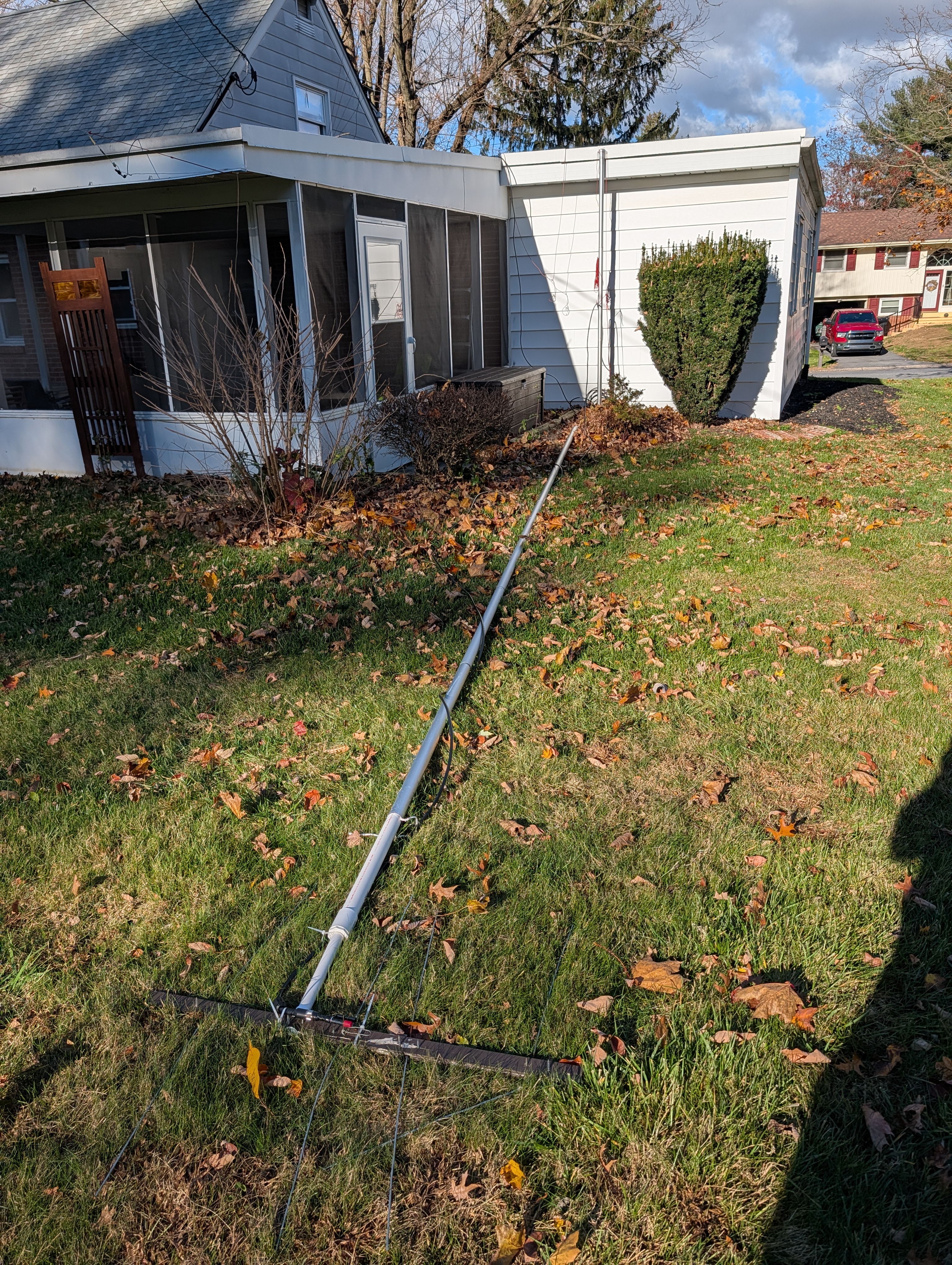
    • threw it again with pulley and halyard: 42 ft
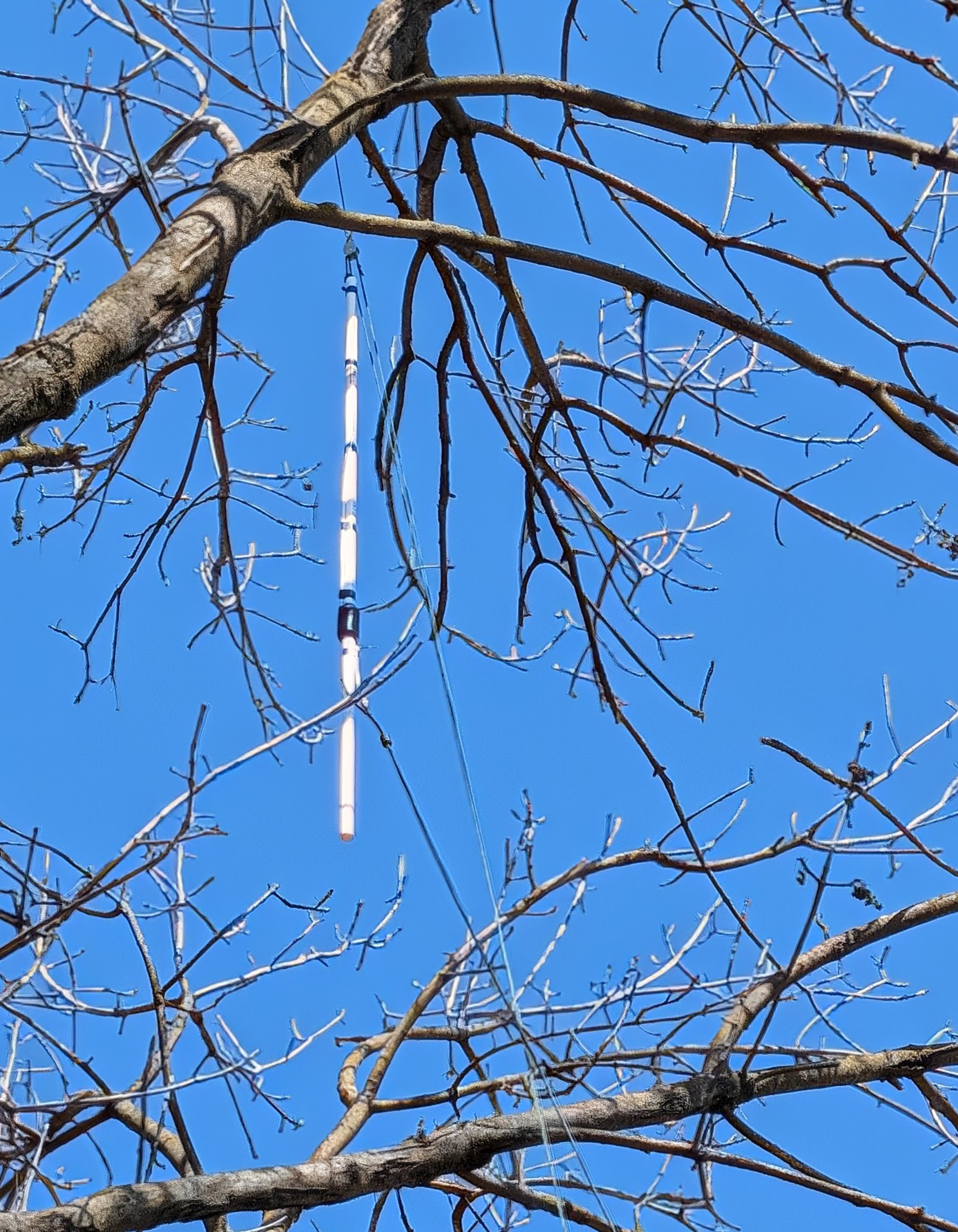
  • built a T2LT flowerpot antenna on PVC pipe and pulled into a tree
    • replaced a slim jim built from ladder line

Others

  • KN3I, John:
    • crowbar circuits to add to old power supplies to recover them
  • W3MFB, Mike:
    • testing some 10M radios to get them back in service
  • W3KZG, Scott:
    • working on some radios for 985-ers
  • KC3RFG, Jim:
    • repairing his fan dipole in good weather
      • replaced balun
      • trouble tuning it after reinstall
      • check the coax and MFJ lightning surge protector: water infiltrated
      • back in operation
      • tested with rooster net on 75M
  • NA3CW, Chuck:
    • AWA PMAM net, hosted pre-net and regular net, 13 check-ins.
  • KD3EMS, Chris:
    • providence, ri over the weekend with family stuff
      • participated in 2 local nets
  • KA3GLI, Dave:
    • starting echolink for upcoming travel
  • WA3KFT, John:
    • helped a friend take down a broken titan antenna
  • KC3OOK, Bill:
    • simplex net, and welfare net
    • pulled power into the shack sub panel
  • KB3ZIM, Bob:
    • a little HF, chasing POTA activators
    • got a QSL card in the mail from a POTA activator
  • KD3AEL, Joey:
    • new tech operator in Gap
    • participating with W3RRR welfare net

Questions

  • KD3AEL, Joey:
    • When the repeater is quiet, how do you announce your presence on a repeater?
    • KB3ZIM, Bob:
      • listening”
      • maybe a couple times
      • operate, operate, operate
    • KC3OOK, Bill:
      • when you do call, wait a minute or 2 for people to get to the radio
    • WA3VEE, Ron:
      • don’t just hit and run, wait a few minutes
    • NA3CW, Chuck:
      • don’t hit and run, patience
    • W3MFB, Mike:
      • say your call nice and slow
    • W3GMS, Joe:
      • Welcome Joey
      • check out the website
      • find the round table as well
      • get the audio gain up: swallow the mic
    • WA3VEE, Ron:
      • on qrz.com, add your email, so we can email you
    • WA3KFT, John:
      • get on the air and practice
    • KD3AEL, Joey:
      • Thank you for the warm welcome
      • looking forward to getting outside with the radio
  • WA3VEE, Ron:
    • Preparing a talk for Pottstown: “Ham Radio Tall Tails, Old Wives Tails, Folklore, Myths, and Debunking Them” Share
    • W8CRW, CR: “Ham radio, do people still do that?”
    • W3KZG, Scott: “What’s the big antenna for? do you talk to aliens?”
    • KB3ZIM, Bob: “All you need is a low SWR.”
    • KD3AEL, Joey: “Ham radio, that’s just like CB?”
    • KC3RFG, Jim: “A perfect 1:1 SWR means your antenna is resonant”
    • W3MFB, Mike: Pottstown has lots of CB-ers switched to ham.
      • “Are you a federal agent?”
    • NA3CW, Chuck: “Ham radio is too expensive”
    • WA3KFT, John: “What do you mean ‘dip the plate’?”
    • NA3CW, Chuck: “this tiny HF antenna is just as good as a halfwave dipole”
    • KD3EE, John: “This is the last HT I’m going to buy”
    • KD3AEL, Joey: “Now that we have cell phones, there’s no need for radio”
    • AF3Z, Jim: “They still use Morse Code?”
    • W3KZG, Scott: “Ham radio people are preppers”
21 Tech Net: 2026-03-01

My Week in Radio

  • On a vacation cruise, so no radios allowed.
  • Wire was down when I got home, so I got to throw it again. I threw it with a pulley and halyard this time: 42ft up.
  • I built a T2LT flowerpot antenna on PVC pipe and pulled into a tree. It replaced a slim jim built from ladder line.
  • I was looking for that Iran station, but didn’t really hear anything.
  • I got me spinning through other 49M shortwave and looking up the station locations.
  • On the subject of open source: ft2.
    • When you write code (or a book), you have copyright automatically.
    • You choose the license.
    • GPL license says: “I provided the source code for free, so you can modify or build upon it, and when you distribute a derivative work, you need to afford your users the same privilege: distribute your modified source.”

Others

  • K3EA, Greg:
    • contests
    • DX report
    • original hamclock server has been duplicated to keep original hardware working
      • hamclock.com for instructions
    • QSL cards in the mail:
      • Equatorial Guinnea, Africa.
      • Anguila
      • Ethiopia
    • KA3TKW, Tom:
      • thanks for update on ham clock
  • WQ8M, Scotty:
    • Parker, CO
    • IRLP
      • project is probably 30 years old
  • VE3HOH, Pete:
    • starting with meshtastic: 1 node found so far
    • considering NVIS dipole for 40M
  • KA3TKW, Tom:
    • Iran radio from London: 0300-1600UTC, 9800khz, otherwise 5885khz, and another
    • 9:55pm: starlink launch to the east/south
  • N7JMS, Jon:
    • FT2:
      • 8 QSOs during net
      • central africa
      • less sensitive
    • Meshtastic: use unlicensed mode, instead of licensed modes, so you can keep standard encryption.
  • WA1SMG, Matt:
    • cornwall townlhip
    • reviving an old lafayette receiver: crystal controlled
      • can be used for CW to satellites
  • KC3VZU, Bob:
    • marveling at the testing experience of older hams
      • drawing radio diagrams
      • 20wpm CW
  • KC3RYQ, Gary:
    • Yaesu 8135 with RT Systems: trying to get it programmed
  • KD3AGU, Richard:
    • first net in 2-3 months *** Swap and Shop
  • VE3HOH, Pete:
    • Kenwood
    • Drake TR7s
  • KA3TKW:
    • 2-3 DX440 SW radios
    • some small Sony SW radios
    • RadioShack 10M mobiles
21  ka3tkw  technet  net  hf  antenna 

T2LT Flowerpot Antenna

I’ve been curious about the T2LT “flower pot” antenna for a while. It’s fed from the bottom and attached to a sturdy PVC pole. I can easily hoist it into a tree, and it has a low wind load, so it could go on top of a flag pole again.

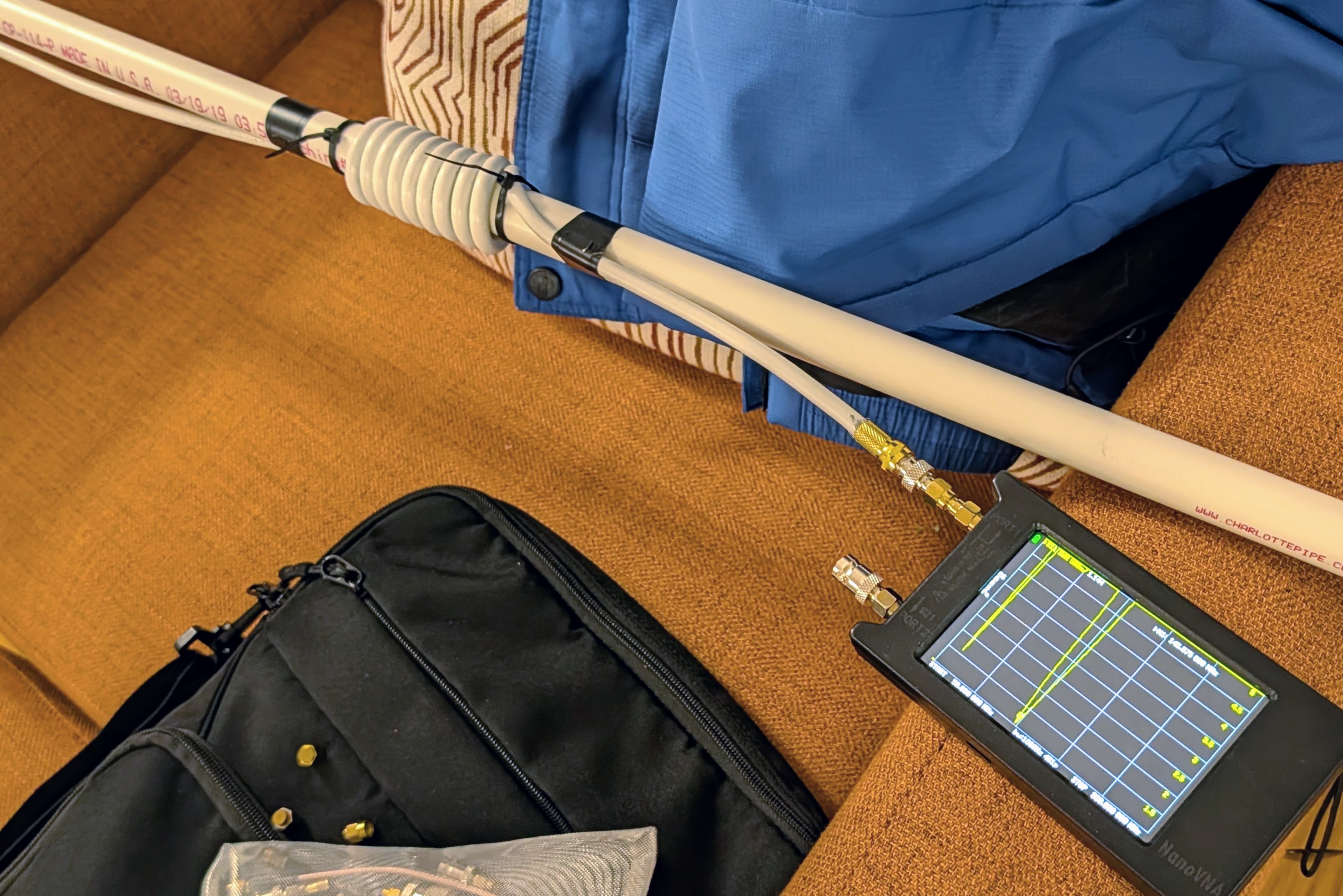
I built it at the SPARC Elmer night from some 75-ohm TV cable I had laying around. I taped and cable-tied it to a thin bit of PVC, and I adapted the feed point from 75ohm TV cable connector to SMA. I had built it long to allow tuning, but it tested to be just about right for 146MHz when I put the VNA on it.

Fixed Slim Jim

The Slim Jim in the tree wasn’t working, so my APRS radio had gone quiet. I started testing with the nanoVNA before going out in the cold to check the connections. I found the lead inside was not passing any signal. The connector at the radio was pulling off the cable, so I could push it back together and re-crimp it. I got away with the easy fix.

985 Workbench: 2026-01-26

My Week in Radio

  • Winter Field Day
    • I logged for CW ops and listened along
    • I could hear 2-3 characters at a time

Others

  • W8CRW, CR:
    • Field Day
  • WA3VEE, Ron:
    • Field Day
      • operated most
      • worked N3FJP, author of the software
      • W1AW
      • W2AEW see on youtube
      • worked with Kianna
  • W3KZG, Scott:
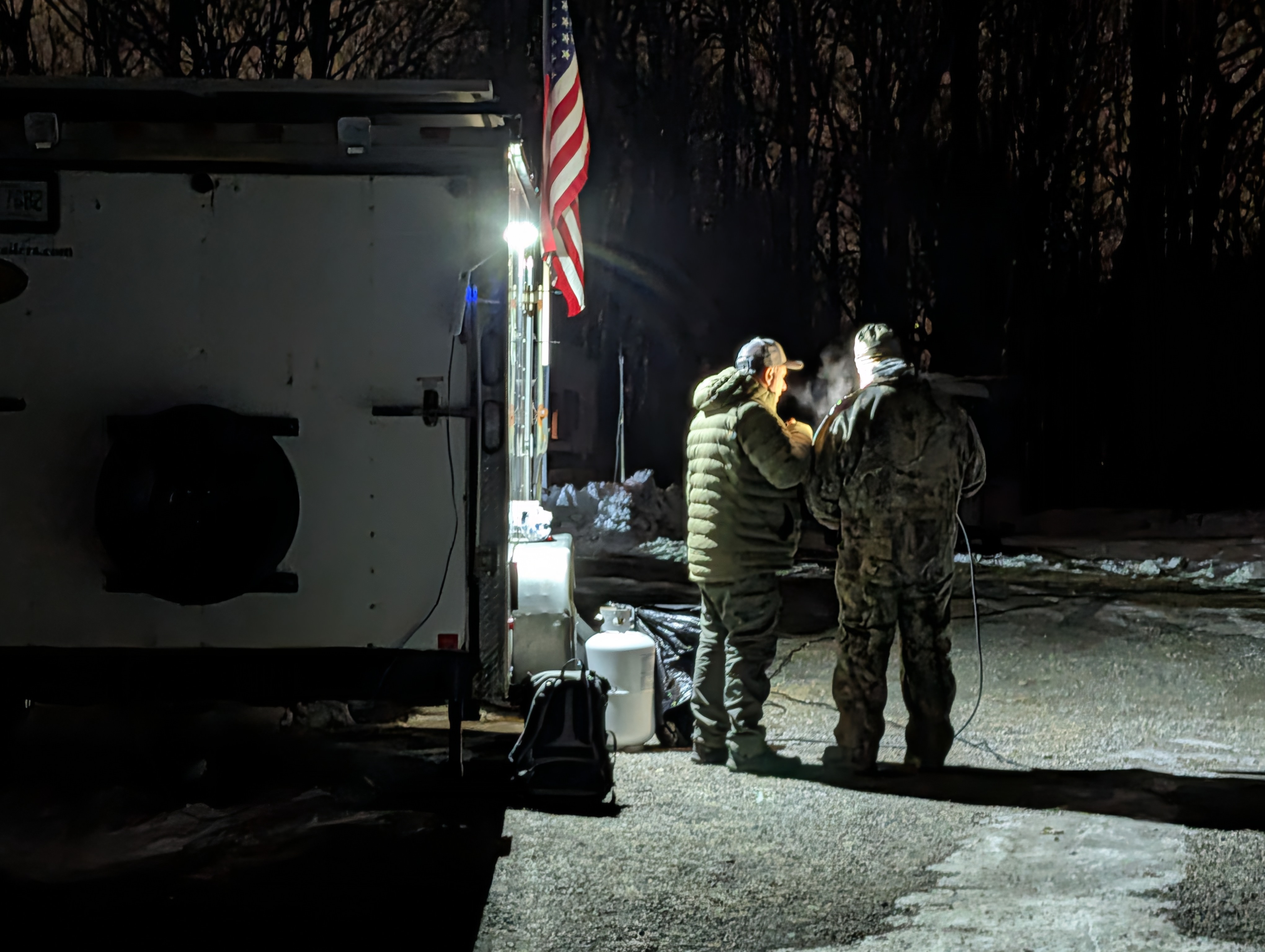
    • field day trailer worked out great
  • KB3PZY, Al:
    • first field day
    • Thanks Harvey for mentoring
    • 30 some contacts
  • KB3ILS, Keith:
    • antennas up at the field day site
    • got to WFD early
    • laptops, network, power worked great
    • 450-475 contacts made
    • SKCC
      • PR on 6M CW
      • Alaska on 15M CW
  • WA3KFT, John:
    • WFD with another club, 75M
      • didn’t hear anyone in the afternoon, all noise
      • early evening it lit up
  • KC3OOK, Bill:
    • simplex net
    • welfare net
  • NA3CW, Chuck:
    • welcome Al
    • antenna install for WFD with lots of people
    • “how to cut a dipole the second time, every time” worked pretty well
    • used Joe’s tuner with 100W testing
    • PMAM pre-net
  • AF3Z, Jim:
    • SKCC month ends on saturday
      • coordinating SKCC ops, had enough of it :)
      • worked 240 contacts with special callsign
    • worked WFD with cornwall station
      • proved total lid
        • operated a Elecraft K3 on 40M
        • heard W3R, but couldn’t get an answer
        • K3 needs VOX enabled for CW, so it wasn’t transmitting
        • quit for the morning
        • realized much later about VOX
  • AA3LH, Leon:
    • winter field day at home: 40M and 80M *** Questions
  • KD3EE, John:
    • What was the problem with the 80M antennas and that radio that rebooted?
    • How significant is the dipole arrangement (flat vs inverted-v) to multi-station operation?
    • W3KZG, Scott:
      • originally thought it was RF
      • switched radio to AC-DC power supply, and then the radio was fine
      • trailers battery may not have kept up with the severe cold
      • new radio couldn’t tolerate voltage drop, but older radio was ok
      • LiFEPo battery struggles under 30F
      • CW dipole showed high SWR at one spot, still needed to be investigated more
    • WA3VEE, Ron:
      • when the weather is better, Ron will run a complete analysis on each antenna on the site.
      • we can talk inductance and capacitance then
      • there seems to be an RFI problem from a power transformer insulator up there as well
    • KB3ILS, Keith:
      • 80M dipole cut for sideband worked well
      • 40M CW in the corner may need some work
      • 1 beam was pointing at the 80M dipole, so likely caused lots interference
      • it’ll be good to analyze when no one transmitting
      • one 40M dipole may be close to noise.
      • some experimenting to do
      • we still got lots of 40M contacts
    • NA3CW, Chuck:
      • power-line interference has been an ongoing issue
      • Chuck has a small moxon for 137MHz that will be good paired with AM on his HT to search for the noise source
        • worked to find a bad pole in his neighborhood
      • inverted vs flat dipole
        • dipoles end to end have very little radiation off the ends.
        • inverted-v antennas would have seen each other on the ends
        • analyzers work with very low signals, so would have totally been skewed by nearby QRN and TX
    • KB3ILS, Keith:
      • Chuck, let’s build a dipole curtain array for field day.
  • W3MFB, Mike:
    • HF vertical can have a ground plane, even in the air or on the ground? They help control common-mode current? Why use them?
    • WA3VEE, Ron:
      • the ground plane is the other half of your antenna.
    • WA3KFT, John:
      • Has the Amtron A99 on a tower without the ground plane kit, but has a TV mast below it on the tower, so may be serving the purpose.
    • W3KZG, Scott:
      • IMAC 2000 antenna, 50 ft in the air without the ground plane kit. The galvanized steel mast underneath it served as the ground.
      • AMTRON 99 came with it, so he installed it. It looks cool.
    • AA3LH, Leon:
      • Used tuned hamsticks in Colorado, and put out lots of radials.
    • KD3EE, John:
      • the computer and radio going wonky (touchpad, USB, etc) always remind me when I need to add radials to my vertical antenna.
    • W3MFB, Mike:
      • With the IMAC, he knows he needs the ground plane kit as it gets higher in the air.
      • His is grounded to a gas pipe, so it seems to work pretty well, and he’s gotten to Australia.
      • Also has lots of coax to absorb it.
      • Has gotten to Australia with it.
  • KD3BPI, Simon:
    • He’s planning for antennas on the house, 2 stories, walk-up attic. He has a dormer facing west, and was planning to mount antennas there. Easy to get to them from attic. Can he mount all the antennas on one plate or should he space them out?
      • regional HF (20m) antenna and dual-band 2m/70cm antenna.
    • WA3VEE, Ron:
      • Personally doesn’t like to have antenna on the house, since it draws lightning.
      • How much land?
        • Simon: L-shaped, 1/3 acre, but no trees that are actually his.
      • 40M would be a good horizontal wire for regional NVIS
      • grounding is imperative for lightning protection of the house.
      • those antennas, in size, are very different.
      • wires are easier for HF
    • W3GMS, Joe:
      • the Hustler 5-BTV for 80-10M is a good option
      • he has radio and tuner for Simon
    • W3MFB, Mike:
      • Hustler in the yard would be a good option
      • pin down the feed line and radials with lawn stakes
      • neighbors trees: any limbs over your property could be used to hold up an end fed antenna
      • get the antenna as high as you can get it
    • WA3KFT, John:
      • He has 5 antennas at the top of a tower, like a candlabra.
      • an edger is good for grooving the lawn for wires
    • WA3VEE, Ron:
      • sent link to the Hustler 5-BTV
      • the digital modes are FT8 and PSK31
    • W3KZG, Scott:
      • Has an NMO lip-mount with dual band antenna clamped to the rain gutter of the shop.
    • KC3NZT, Harvey:
      • using a copper pipe j-pole inside in the attic of the garage.
        • should work just fine.
      • an HF antenna in the attic would work fine too
    • WA3VEE, Ron:
      • for new hams and those in HOAs, attic antennas can be effective
    • W8CRW, CR:
      • Why’s the 5-BTV so highly recommended, compared to other variations?
      • WA3VEE, Ron:
        • the 5 walks the line of versatility and size
        • they’re different sizes
    • W3GMS, Joe:
      • a 4-BTV is 4-bands, 5- is 5-band, etc.
    • KA3GLI, David:
      • on the 5-BTV, what auto-tuner is recommended?
      • W3GMS, Joe:
        • LDG RC-1 auto-tuner helps match as you get away from the vertical’s narrow, high-Q, resonant spot.
    • KD3EE, John:
      • remember you can build these HF antennas with some wire and toroids.
  • KD3BPI, Simon:
    • How does height affect performance of a vertical: ground vs roof?
    • W3GMS, Joe:
      • wire radials on the ground are easy. detuned by the earth.
      • lots of short radials are best
      • elevated radials will perform better, but will require tuning of radials.
      • random lengths are fine on the ground
    • KC3WRY, Matt:
      • a ground-mounted antenna is easier to tune, instead of up in the air.
      • ground-mounted can always later be moved.
    • WA3KFT, John:
      • worked at an AM radio station.
      • when they moved, they rebuilt all the radials.
        • 60 short and 60 long radials
    • W3GMS, Joe:
      • 8 radials with the 5-BTV at the beach was fine
      • gains aren’t as impressive after the first radials

Flagpole Mast Down

The flagpole mast broke in the wind about 9:05pm EST or so. I captured the destruction on the Wyze camera that watches it. It snapped right above the point it’s tied to the garage. Fortunately, it fell in an OK direction, so it didn’t damage anything around it.

I could try to put it back up with some spare pieces and guy it next time, or I could try the military surplus mast I picked up at a Ham Fest this past summer.

I’ll be contacting the 985 repeater digitally through Allstar for now.

Higher Home Antenna

I watched Youtube and saw a better way to throw the line by cradling the weight on the line and swinging the weight between my legs. It’s much more confident, powerful, and accurate. I threw my home antenna higher in the same tree. It’s so high that I needed to add more throw line now.

!–more–>

RX with Disconnected Antennas

K3IR/145.230MHz for the Morning Grind was clear, but low power (S3-S5) on the Quansheng and TH-9800 base. It turns out that both antennas were disconnected at the window for overnight storms.

High SWR 80m EFHW

I was seeing high SWR on the 80M EFHW: over 3:1+. I found counterpoise was chewed and broken, so I twisted it back together, but I saw no change. I disconnected the counterpoise completely, and that made no difference: still 3:1. I finally unscrewed and re-screwed the rusty alligator clamp and reattached it. That fixed it!

Previously, it seemed I’d sometimes see high SWR for a a moment, then it would recover. It seemed like giving it a little power would “clean up” something.

efhw  80m  antenna 

64:1 Unun for 80M EFHW

Today I experimented with building a 64:1 unun for an 80-meter EFHW.

My initial attempt involved 3 primary / 24 secondary windings, but I quickly found that this took up too much space on the small toroid I was using.

After some adjustments, I settled on a 2 primary / 16 secondary windings, adding a 100pF capacitor. This configuration was inspired by resources like KM1NDY’s DIY linked EFHW 64:1 antenna guide.

I’m now successfully running my home EFHW antenna on 40 meters without needing a tuner. On 17 meters, the SWR is a bit high, so I engage the tuner for that band.

This setup reminds me a lot of my previous 71-foot random wire antenna with a 9:1 balun. I’m noticing a significant increase in the number of signals I’m receiving, which suggests this new EFHW might be a considerable improvement over my old 107-foot EFRW.