Backyard Alternate Antenna

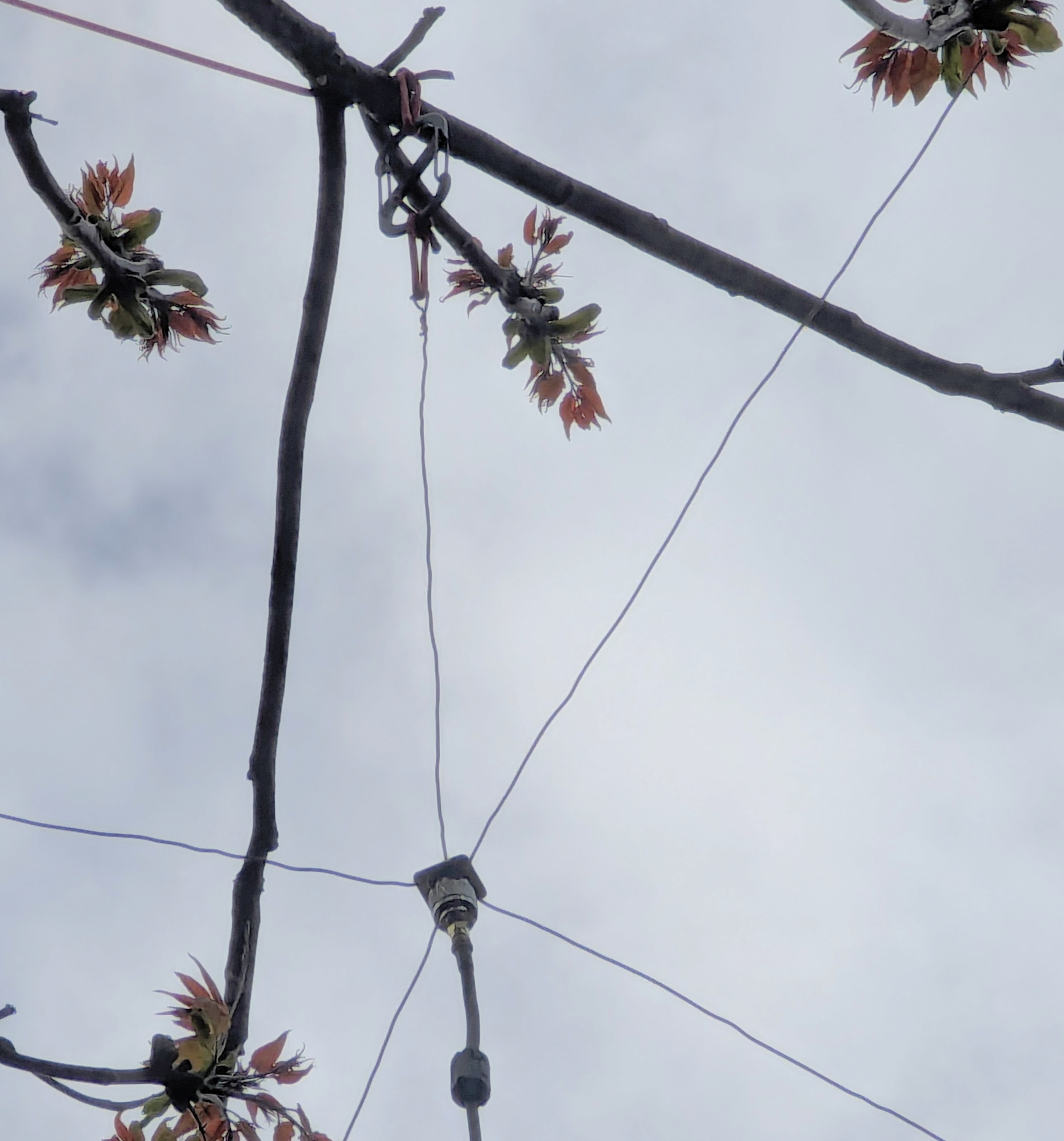
I cleaned up the backyard a bit, and ran a new 12.5m (41ft) random wire up the hill behind the house.

My first tests the next day on 30m at 1W got me some contacts. By 4:40pm EDT, the bands were all in “poor” condition, so it got tough to test.

The next morning, I watched the 40m band close. It was ablaze at 8am, but getting pretty quiet by 10:30am EDT.

I compared the old antenna out the front with the new antenna out the back using FT8 and PSKReporter.

The back antenna saw fewer decodes on 15m on average. It mostly lacked any stations from Europe. Looking at the antenna’s physical attributes, it starts on first floor (lower than the old antenna) in backyard, but it slopes up more vertically. The middle of the antenna, on average, is blocked by the hill to the East.

The old antenna out the front saw more decodes overall, including Europe. It starts at second floor window and only slightly angles up. The whole antenna is higher and clears the hill, even though Europe may still be mostly all the end of the antenna. It performs better.

I had fun physically launching the new antenna, but I’ll need to do some more work to get more of it higher in the air to be useful.
hf  antenna  ft8 

Spin 30m

I spun the dial below the 30m ham band at the end of the night, and I caught all kinds of interesting broadcast (31m) and HF air traffic.

30m  swl  hf 

985 Workbench - 2024-04-29

My Week in Ham Radio

  • Built and deployed a 1/4 wave ground plane with radials
    • wire soldered to an UHF chassis plug
    • fed from the bottom
    • hung in a tree by cord
  • York Hamfest and 2 parks out that way
    • Codorus
    • Sam Lewis
    • EFRW
    • Mostly ft8
    • 40m hot at 5:30pm
    • 2 phone contacts in Canadian parks for park-to-park QSO
    • Took some time to experiment a little
    • Fishing pole mast with 3D-printed fork on the end to catch the wire
    • Stop pulling on coax…loosened ends
  • SPDX RTTY contest (Poland)
    • 2 contacts
    • ended at noon UTC on sunday, so ran out of time
  • AubsUK firmware for Quansheng
    • 10 scanlists
    • automatic scan on power-up, feature request
  • Picked up a new podcast: Ham Radio Workbench
  • Simplex Net: heard 16 of the 38 people

My Questions

  • with nicer weather and time to experiment with antennas, how would you recommend iterating and experimenting? I have:
    • the QRP transceiver
    • digital modes & pskreporter
    • nanovna
    • some modeling software I could learn
    • the latest ARRL Antenna Book

Discussion

  • Dipoles, sloped or flat?
    • Flat leaves nulls toward the ends
    • Sloped fills it in to be a bit more omnidirectional
    • An antenna close to the ground is going to be NVIS
    • Vertical is omnidirectional
  • Ron’s seeing infinite SWR on the “screwdriver” antenna.
    • Others have had problems as well.
  • Mike wonders about viability of using 6m FM in his area
  • My Question: How should I evaluate and structure my experiments with antennas?
    • Conditions change constantly
    • Learn to read solar data
    • Take notes on conditions and try to test in similar conditions
    • Vic’s experiments:
      • endfeds
      • hamsticks
      • radials
      • aluminum screen or faraday cloth for ground plane
    • WSPRnet and pskreporter help gauge how you’re getting out
    • See what you can hear
    • Qualify callsign for different tests, so I can tell them apart in pskreporter: kc3wwc/a, kc3wwc/b, etc
  • Ken wonders about TNC for packet radio on HF/VHF
    • Glenn, N3MEL would be the person to contact
  • We heard lots of interference and doubling in the beginning of the net
    • This was likely another manifestation of intermod
    • Tropospheric ducting happens more in morning in the summer

ISS Repeater

The ISS passed at 8:55am EDT at 49 degrees. My vertical 1/4-wave ground plane antenna in the tree picked it up really well. I copied a handful of callsigns pretty easily:

  • KO4PDI - FL
  • KC4Y - AL
  • K4MMD - FL
  • N5ACR - MD
  • KC4YMT - GA
  • KC3MM - SC
  • K3DMM - PA, Harrisburg

I confirmed hearing K3DMM on the Morning Grind round table (K3IR) a few minutes later that morning.

iss  vhf 

York Hamfest and POTA

York Hamfest

I ran to York for the Hamfest and I saw a handful of new friends from SPARC and 985. I only bought some BNC adapters, a speaker that’s OK but not great, and a wireless keyboard/touchpad for my Raspberry PI projects.

POTA

While I was out, I figured I may as well play a little radio and activate 2 parks.

Codorus, US-1342

I ran the 12.5m EFRW stretched from high in a tree to a picnic table. I started at the picnic table, but moved into the car when it started to rain. To reach the car, I stretched my coax a bit and camped that to the table, and I ended up with no signal. The feed cable (RG174 with SMA connectors) had pulled loose from the SMA connector, so I had to debug that and push them back together. I operated 17m mostly, FT8, and contacts came a bit slow.

Sam Lewis, US-1418

This time I stung up the 21.56m EFRW, 2-3m off ground on ends, stretched between trees, and a fishing pole mast supporting the middle peak. 17m was still a bit slow, but 40m was hopping for FT8. I had a steady stream of contacts.

Before packing up, I spun the dial and found a park-to-park SSB on 40m: 2 operators on one radio at the intersection of 4 parks in Canada, so that counted for 8 hunter points.

york  hamfest  pota 

Quarter-Wave Ground Plane Antenna

I followed calculations and instructions to build a quarter-wave ground plane antenna from some wire and a UHF connector that I picked up at the last Ham Fest in Harrisburg. I cut everything a little long and soldered it together. I trimmed the radials to about 54-inches and folded and rolled the radiator wire to a length that is resonant at 147MHz. I measured with the NanoVNA. Once it was at the right frequency, I found that bending the radials up and down could adjust the SWR at its lowest point on the graph. Keeping the radials slightly flatter had a lower SWR than the 45 degrees suggested in the original design.

This ground plane antenna feeds from the bottom, which is physically more sound than the vertical dipole I had up previously. I tested it last night when I strung it up, and it reaches Harrisburg and Parkesburg with no problem.

antenna  2m 

SPARC Membership Meeting - 2024-04-23

Joined the Club

My membership was approved, so SPARC now has 146 members. Mark asked if I’m a climber. It sounds like lots of people chicken out about half way up when climbing the tower. When studying for my license, I didn’t commit a lot of the tower stuff to memory, since I didn’t expect to be involved in that sort of thing.

Ham Fest in York

SPARC will be at the Ham Fest in York with some “ham junk” for sale. Ralph, from Radio Shack, bought Souders’ small hardware business, so he’ll have all those small accessories there. Testing will be available at the Ham Fest on a walk-in basis.

Other Programs and Notes

  • Breakfast in Manheim, every 2nd Saturday, at City Star Diner.
  • Mike is building fox hunt transmitter. Someone else is building a battery for it.
  • Tech classes will start again, Maybe on Mondays. Someone suggested conducting a mock net for training.
  • UHF repeater is working. Full-time tied to VHF.
  • Field day is coming up soon at the club house.
  • There may be room for me to help with website maintenance.
  • Some people are going to Dayton Ham Fest.
  • Trying to use Ham Club Online again to manage membership. It’s a database for ham clubs. Ares is on it.
  • Balun Designs is a good source for durable hardware.
  • HFQso runs nets for testing propagation.
  • There’s an Appalachian Trail APRS Golden Packet event to pass an APRS packet the entire length of the trail.
  • Podcast: Ham Radio Workbench
    • An old episode (1 year ago?) had Vance, N3VEM, doing rocket stuff.
    • I’m never going to finish my podcast list.
  • I chatted with JJ, KC3QEH. I need to look into his POTA activations.

Club Net

I checked into the club net for the first time tonight.

Aubs Firmware

I’m trying out the Aubs 00.07 firmware on my Quansheng radios. It’s based on the latest egzumer, and so far has kept up-to-date, and it has its own plugin for Chirp.

It has some really cool features for scanning:

  • scan on start, a feature I requested of egzumer, but was denied by egzumer.
  • 10 scan lists. I organized mine as:
    • 1 = local repeaters and popular simplex
    • 2 = all simplex, Ham and GMRS
    • 3 = non-local repeaters and other listening
    • 4 = satellites
  • press * to lockout a frequency from scan.
  • fast scan like egzumer
  • frequency spectrum analyzer, but no memory spectrum analyzer like nunu.

This is my daily driver now on both my radios.

985 Workbench - 2024-04-22

My Week in Radio

  • I met some 985ers on Friday morning at the tailgate and breakfast.
  • I heard a bit of the ARISS mission talking to students last week
  • I have APRS working
    • UV-K5 running egzumer
      • VOX mode
      • Sensitive
    • Pixel 6 Pro
      • Volumes way up, nearly 100%
    • BTech audio cable
    • APRSDroid
      • AFSK mode
    • Saw decodes on the phone
    • Saw myself show up on https://aprs.fi map
  • Evolve 3 laptop is working with Linux completely:
    • network
    • sound
    • used it for a pota activation
  • Time to also slim down the go box for POTA as it’s gotten heavy.
  • 2m dipole in the tree working well for a couple weeks, so it’s time to change.
    • next: try building a ground-plane quarter-wave with radials
    • it’ll feed better from the bottom
  • Trying other firmware on the Quansheng radios
    • mixes of features I want and don’t want
  • W3FIS, Paul Ross, sent me a small box of some radio gadgets to explore
  • I’ve been seeing people recommend using a CW decoder
    • maybe try the decoder in my radio
    • get some practice keying, instead of waiting
  • York Hamfest is on Saturday

APRS

The Working Configuration

I’ve gotten APRS working with my current gear. I’m running my UV-K5 running egzumer 0.22.0 and VOX enabled. I set the radio volume pretty high, about 75%, and connected the BTech APRS cable and a USB-C 3.5mm audio adapter to my Pixel 6 Pro for an audio connection. The volume on the phone was set to nearly 100% volume. I ran APRSDroid in AFSK mode on the phone.

I watched for my position to show up on the map on https://aprs.fi/.

The Stuff That Didn’t Work

With nunu firmware, I needed to key it manually, but it worked. VOX didn’t work in the nunu 0.20.5, so I switch back to egzumer for working VOX.

Next Steps

I’ll next try to find an old phone to run the APRSDroid and try to use the Explorer QRZ-1, so I can dedicate some hardware to this project.