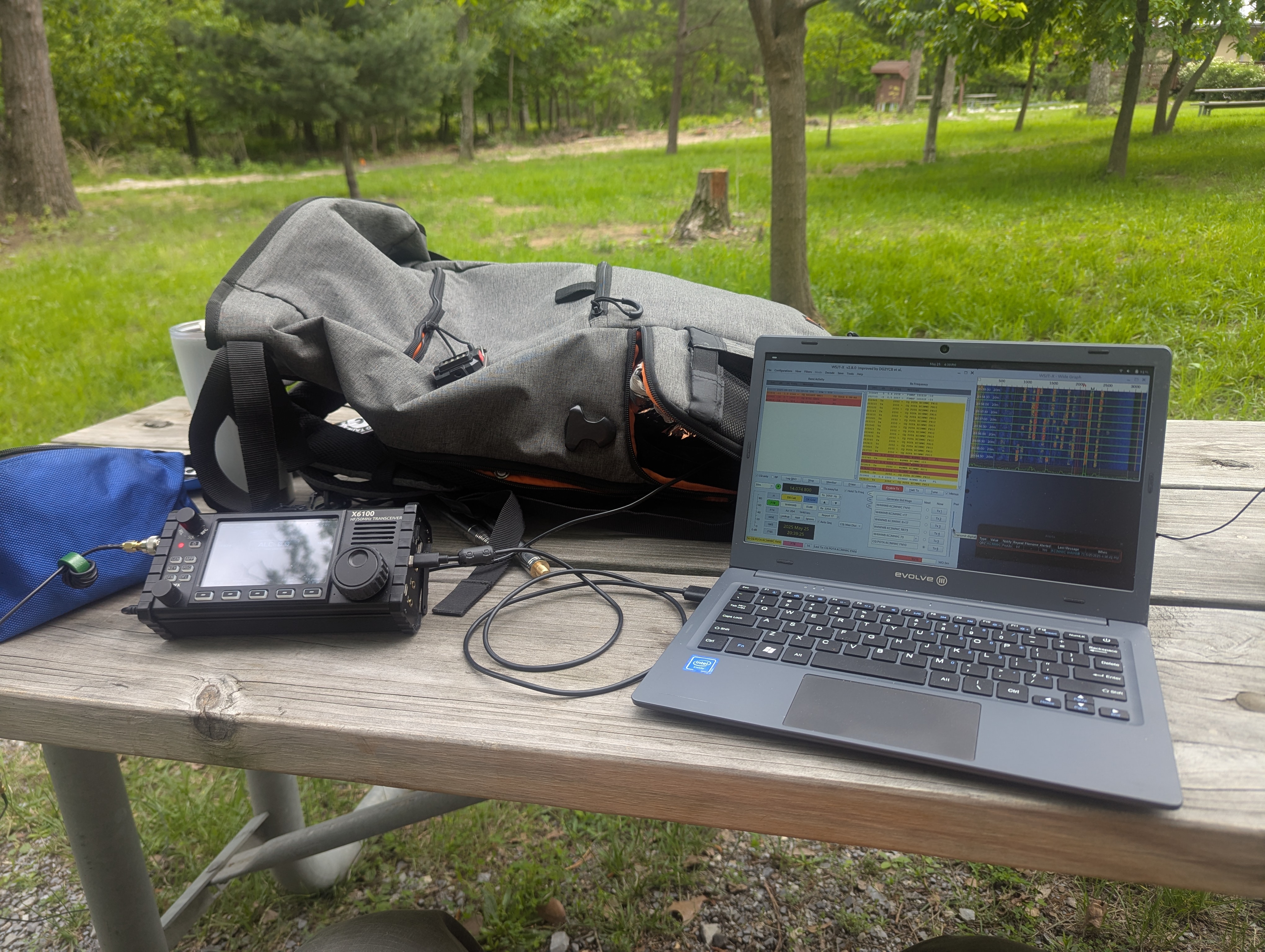
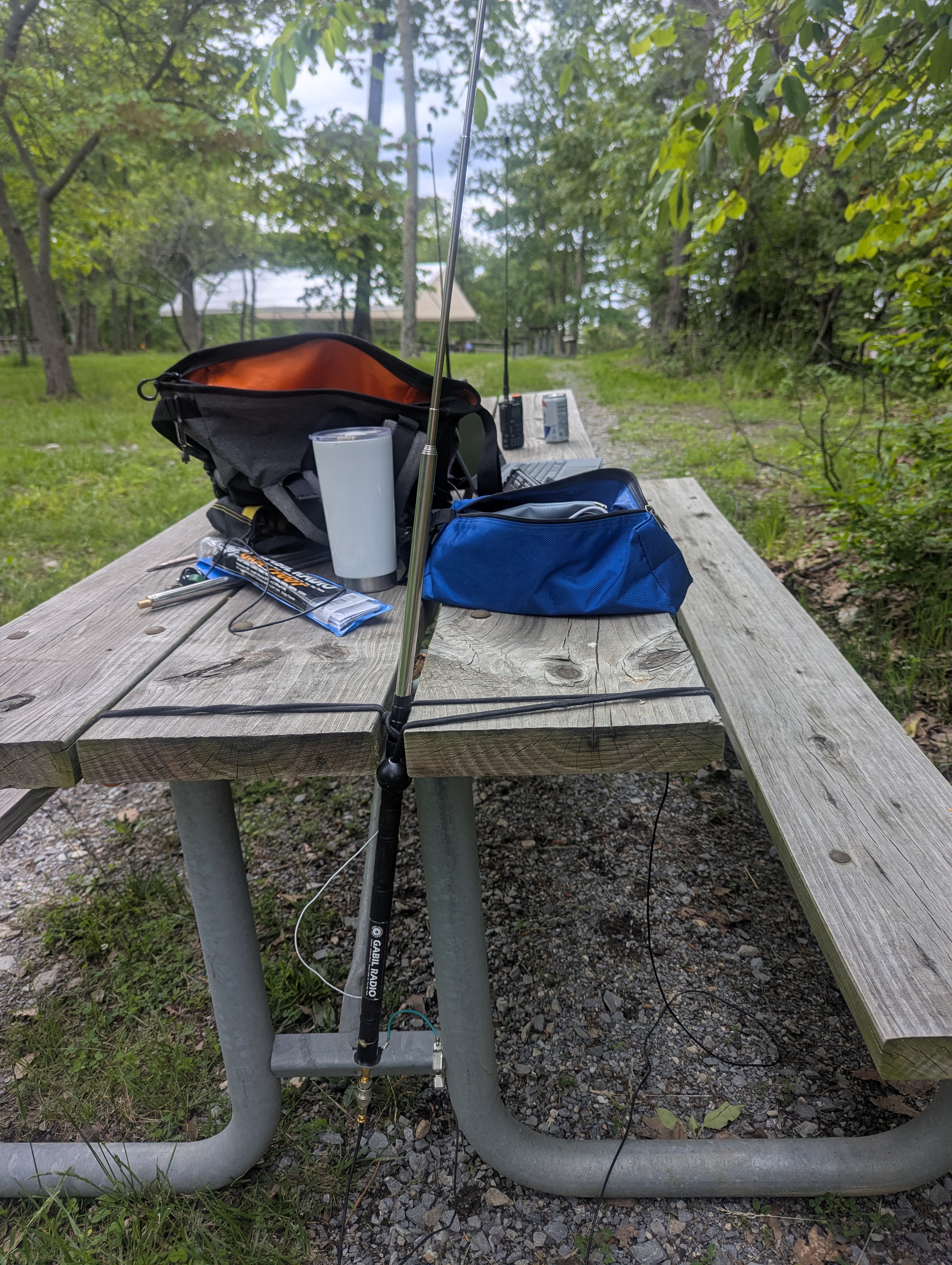
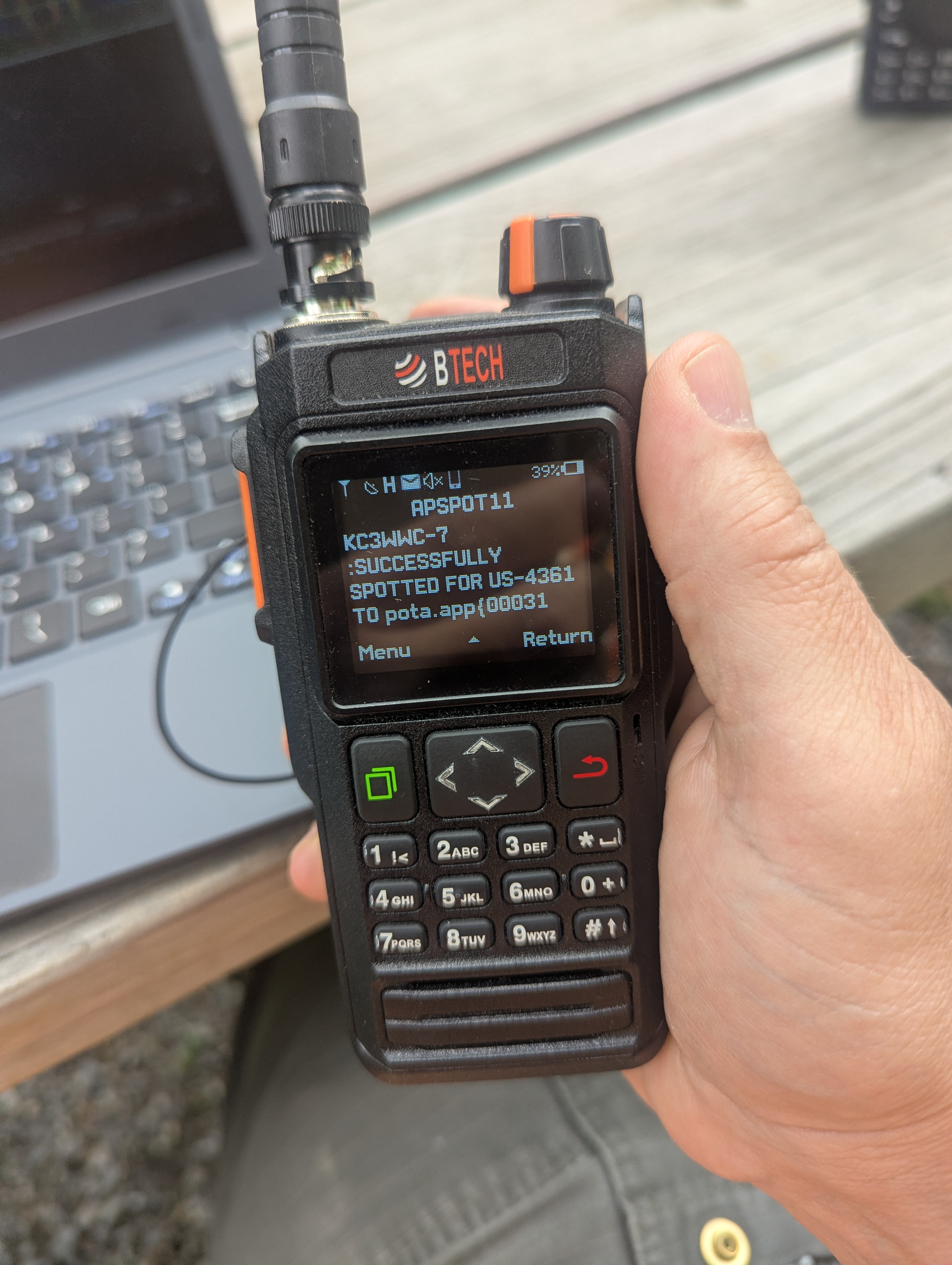
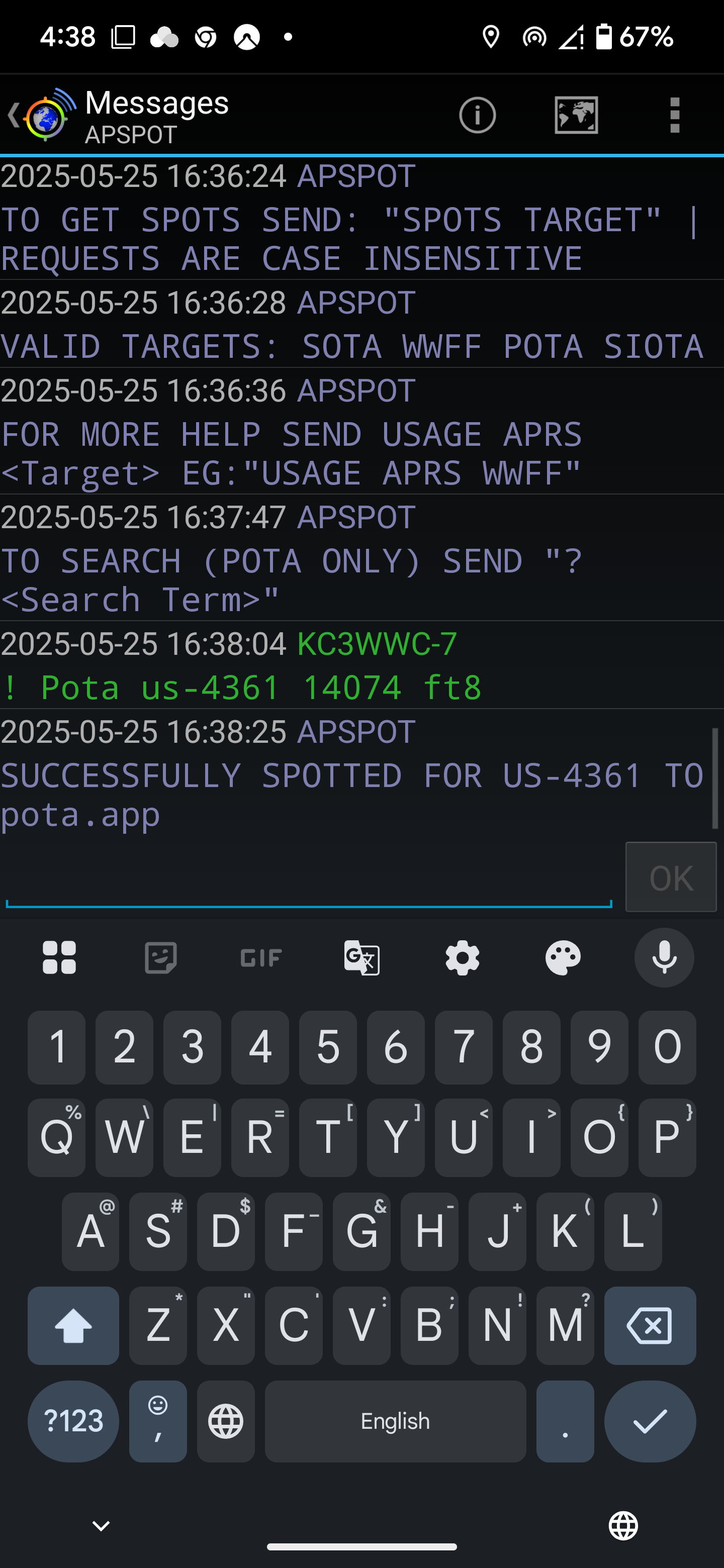
The activation at King’s Gap Environmental Education Center, US-4361 was tough-going, even though I was at the top of the mountain. I used the GRA vertical whip with tapped coil. Internet access flaked early, so successfully spotted myself on APRS with APSPOT.
1W on 40m
Today I had some success operating 1W on 40m.
At 1330UTC, I made a handful of contacts, and got a strong -05 report. I even got a POTA in FL.
21 Tech Net - 2025-05-18
My Weeks in Radio
- French Creek State Park (US-1355)
- All FT8, 1-2W.
- Tried PSK, but no one responded.
- 80M EFHW, 130ft
- Built a 64:1 unun for it to help match better than the 49:1.
- Resonant in many places, maybe need tuner in one band.
- Customizing Allstarlink node to make it easier to manage.
- New R1CBU firmware for my X6100.
- Getting tempted about the zbit or sbit, but the X6100 scratches that itch for being able to customize it.
Others
- WB3LNY, George:
- Dayton Hamfest.
- KA3TKW, Tom:
- No net on holiday weekend.
- Enjoying zbitx and zbitx.
- Visited club in Letterkenny, satellite presentation.
- New power connectors for the zbits.
- VE3HOH, Pete:
- Tried 6M with a quarter-wave on mobile.
- Worked well, trying some repeaters.
- Working simplex on trip from Pottstown to Pine Grove.
- Fixing connectors.
- 100W.
- Tried 6M with a quarter-wave on mobile.
- W3MW, Don:
- 2.4GHz station ready to go with loop yagis.
- Soon will have 5.6GHz by next month.
- UHF pre-amp.
- Pre-amp is more necessary, at the antenna, on these higher frequencies.
- KC3VZU, Bob:
- Looking into RADTEL 880 w/ HF, VHF, UHF, SSB, 10W.
Swap and Shop
- W3MW, Don:
- IC7300, 100w, portable, tuner, pack setup.
- Looking at Yaesu, FTX-1.
US-1355 French Creek POTA Activation
I visited French Creek State Park (US-1355).
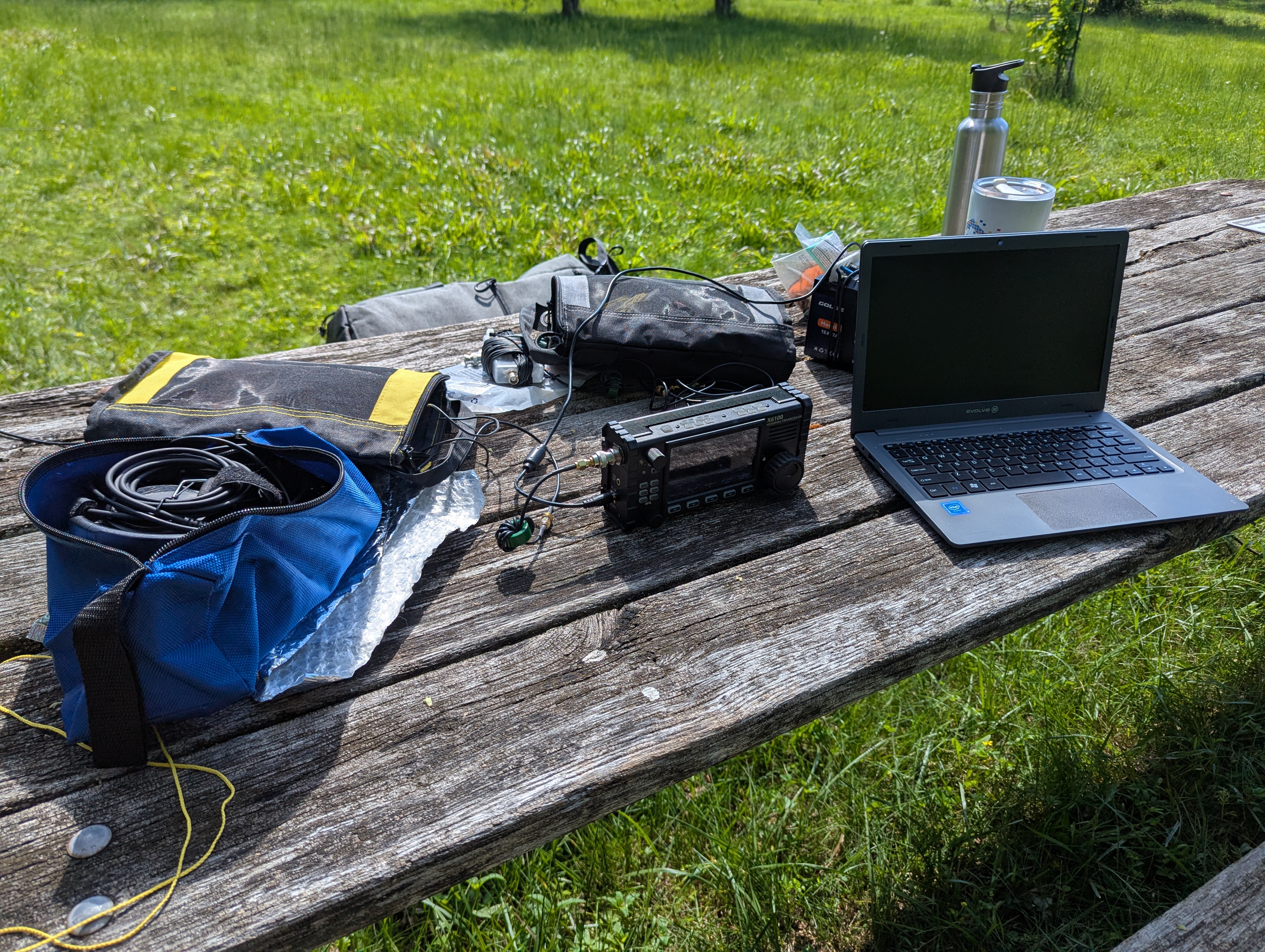
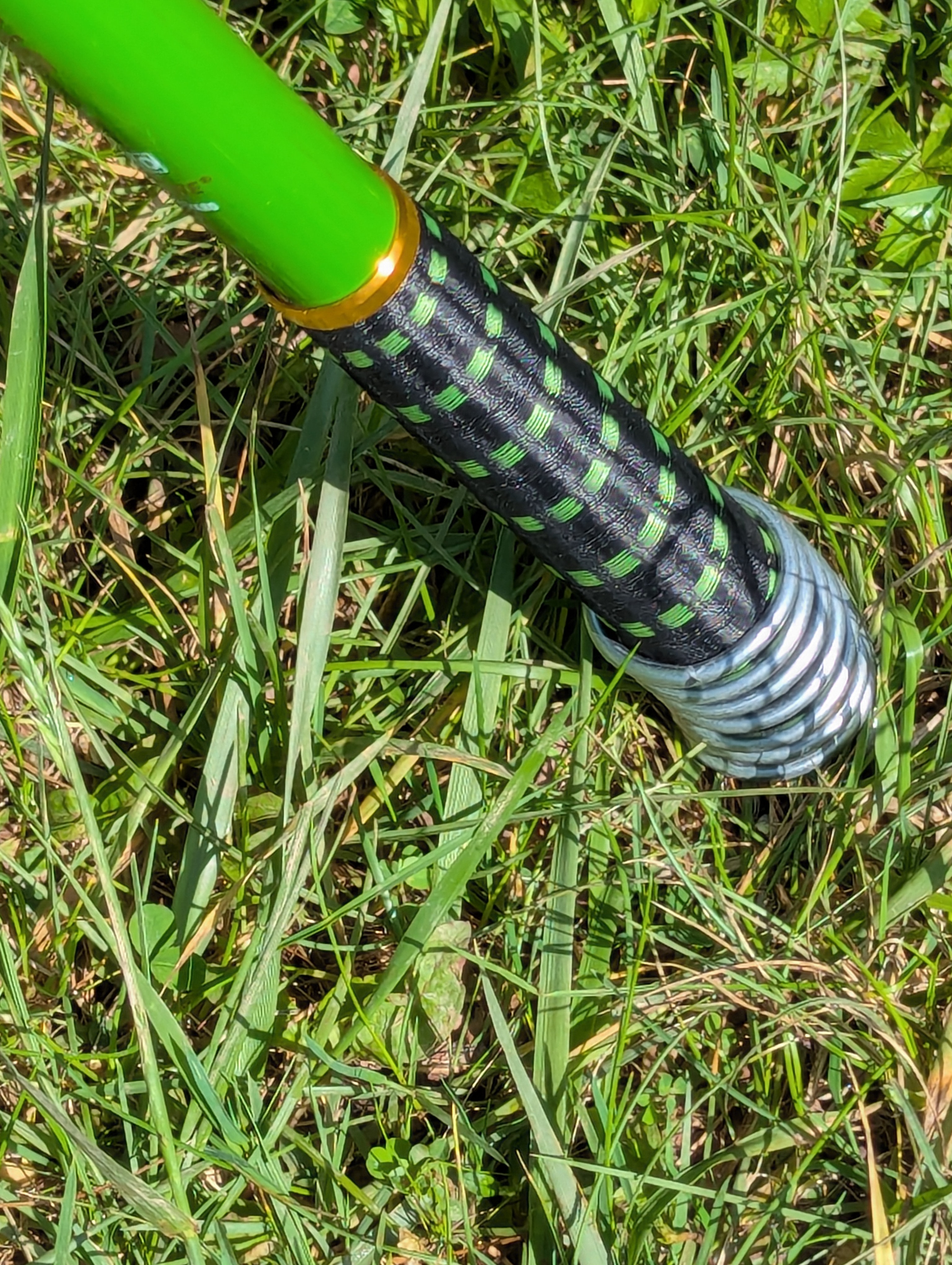
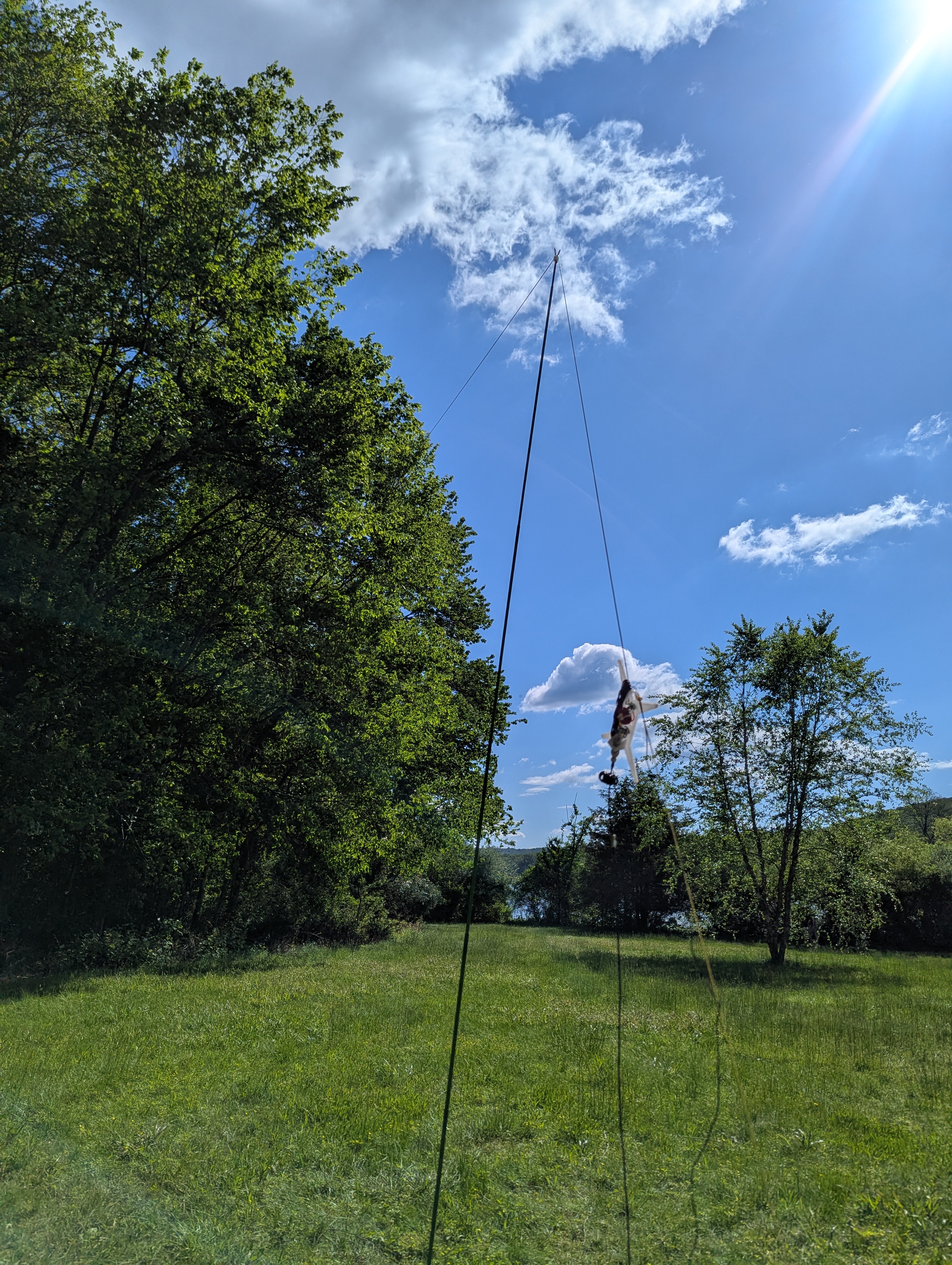
I deployed my 40-meter EFHW, strung up into a convenient tree. I operated with low power, typically between 1-2 watts, on the 10-meter, 40-meter, and 20-meter bands.
I primary operated FT8, and I also attempted some PSK, but no one responded.
Allstar Link Macros
I finally got my reboot command working correctly on my Allstar node:
79 = cmd,shutdown -r now
I also set up a convenient shortcut
to connect to the 985 Allstar node.
Now, instead of typing out the full connection string,
I can simply dial *51* to connect.
The macro definition for this is:
[macros]
1 = *353085
I can *6 to quickly disconnect
from all active connections.
64:1 Unun for 80M EFHW
Today I experimented with building a 64:1 unun for an 80-meter EFHW.
My initial attempt involved 3 primary / 24 secondary windings, but I quickly found that this took up too much space on the small toroid I was using.
After some adjustments, I settled on a 2 primary / 16 secondary windings, adding a 100pF capacitor. This configuration was inspired by resources like KM1NDY’s DIY linked EFHW 64:1 antenna guide.
I’m now successfully running my home EFHW antenna on 40 meters without needing a tuner. On 17 meters, the SWR is a bit high, so I engage the tuner for that band.
This setup reminds me a lot of my previous 71-foot random wire antenna with a 9:1 balun. I’m noticing a significant increase in the number of signals I’m receiving, which suggests this new EFHW might be a considerable improvement over my old 107-foot EFRW.
985 Workbench - 2025-05-12
My Week in Radio
I ran APRS in the mountains past Carlisle and observed many of the same nodes, indicating a wide reach. I also installed and began testing the new R1CBU 0.30.0 firmware for my X6100 HF Radio. Additionally, I launched a new 80m EFHW antenna, and I’m seeing all the harmonic resonances near the right places, though it still needs some tuning.
Others
- WA3VEE, Ron: High schoolers are listening, so we should say, “Hi”. A new club might be forming.
- W8CRW, CR: Participated in regular nets.
- KC3SCY, Luke: Recommended getting a General class license for access to more frequencies. He failed to get onto the AM PM net.
- KD3ZIM, Bob (relayed by Ron): Advised getting licensed early and having fun.
- NA3CW, Chuck: Stated that the AM PM Net is shifting to avoid overly long propagation and interference. He’s still working on Joe’s tuner, and pieces are coming in for Joe’s tower as well.
- KD3AIS, Tim: Attended a ham group where he was considered a “young person” at 51! He attempted to participate in a 10M net but failed.
- WA3KFT, John: Building another 2M/440 antenna and making cables. He’s soon looking for help finishing up those projects.
- W3QP, Tim: This weekend is the SOTA North East meetup.
- KC3YIG, Dave: Working on a home-made vertical antenna.
Questions
-
W8CRW, CR: He’s using lithium phosphate batteries in his car and lead-acid in the shack. Does anyone have experience trying to desulphate a battery that won’t take a charge?
- NA3CW, Chuck: Has a charger that claims to desulphate a battery, and it seems to work. He “jumped” the battery with a power supply to get it started, then ran the desulphating charger for a couple of weeks.
-
KD3AIS, Tim: He’s a Technician studying for his General license and is trying 10 meters. He visited the 10-10 org website, looking at propagation charts and nets, which showed poor propagation. Are these sites correct?
- W3QP, Tim: Those charts provide good information but are not the final word.
- NA3CW, Chuck: Ten-Ten is a good organization, but suggests throwing out a CQ, as everyone could be listening.
- WA3KFT, John: Watching 28435kHz for DX chat and local nets.
- KC3WWC, John:
Check
prop.kc2g.orgfor in-depth information. - KC3SQI, Wayne: Tune down through the digital parts of the band and looking for activity.
- WA3VEE, Ron: Try Ham Clock and the DXView site, note that global conditions may not match local conditions.
-
KC3WWC, John: Is there an easy way to do preset connections in Allstar 3.
- W8CRW, CR: Look into Supermon.
Launched 80M EFHW Antenna
I launched my 80M EFHW at home, replacing my previous random wire setup. I’ve trimmed it up and folded it back, but it still needs the tuner to touch it up. I’m seeing the expected harmonics near each ham band, which is a good sign. My next step is to build a new 49:1 transformer for it.
R1CBU 0.30.0 Firmware Update
Changes
R1CBU 0.30.0 brings several notable changes:
- The ATT/PRE indicator has been split again, allowing them to operate independently.
- A fix for storing/loading of the ATU network has been implemented. This is a different implementation from the PR I submitted.
- Controls for an alternate patched baseband have been added, though I haven’t tried the new baseband yet.
Testing
The software continues to reload preferences from the previous version, which is good. The UI changes look promising. However, the Maximum Usable Frequency (MUF) has been low for the past couple of weeks, making 20M barely usable today. Despite that challenge, I can still see my reports on PSKReporter on 20M. I’ve been keeping my power at around 2W for the past couple of months. My first contact with this new firmware was hunting a park near Memphis, TN, on FT8, using 2W.
APRS in Gardners
I had my UV-PRO and APRSDroid running at Mountain Creek in Gardners, PA, using a normal telescoping antenna. The APRS traffic I observed looked pretty familiar to what I typically see around home, with a wide range of activity and some of the same digipeaters.